| Org Topologies™ |
The Org Design Drop
25 Nov 2026 |
|
| Leading the Agentic Shift with a Broad Outcome Mandate |
 |
|
| |
|
| Hi there, |
| Welcome to Agentic Shift #2: from counting output to owning outcomes. |
| Two weeks ago, our newsletter shared the first agentic shift, from narrow specialists to complete craftspeople. To remind you what it was about: thanks to AI, people can become complete. They can now own the whole skill set of their product and pick up new skills when the work needs them. | 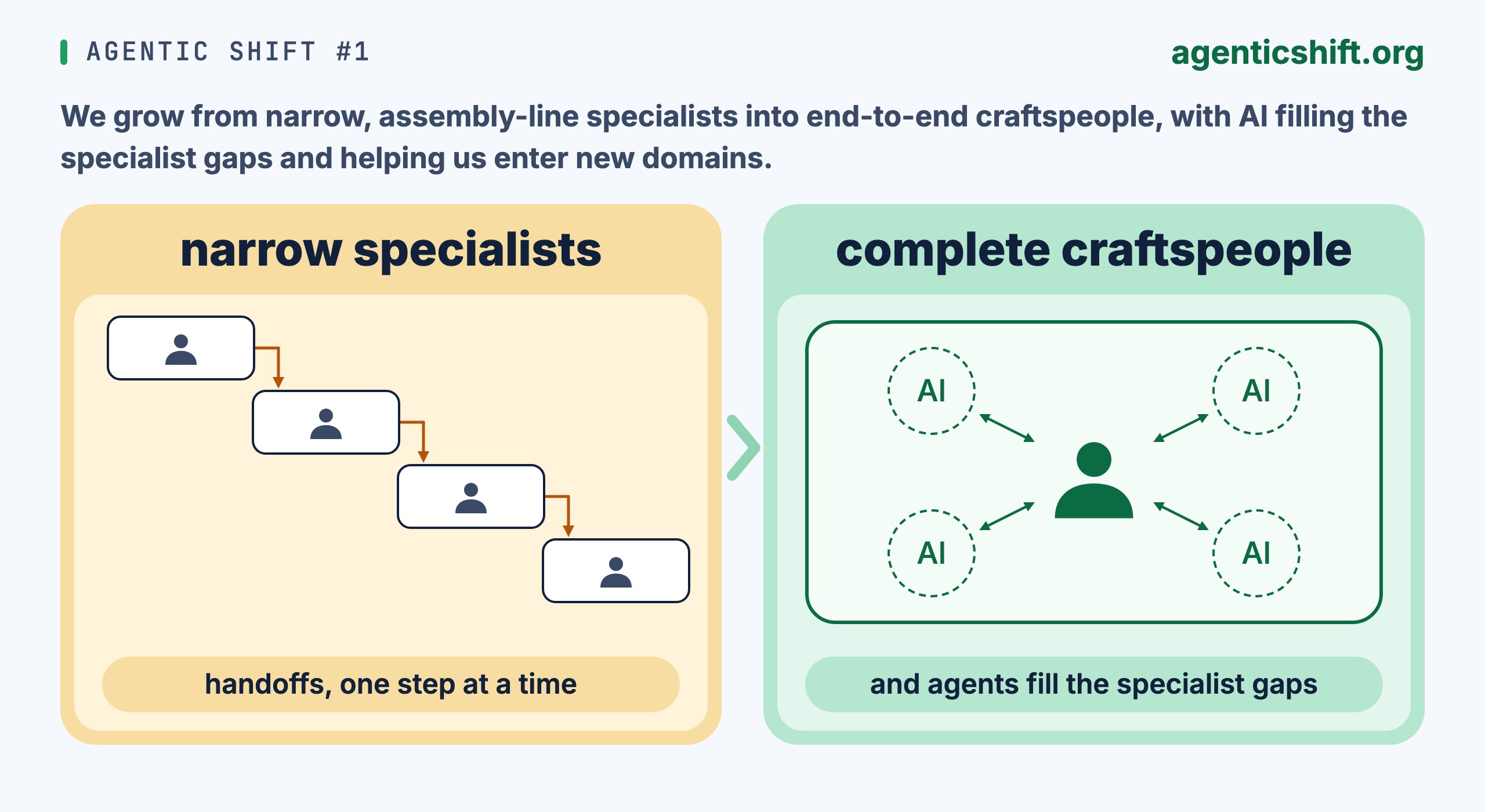 | | But is a broad set of skills enough to make an impact? The often-quoted Ferrari effect is a real risk: everyone is fast, every engine is revving, but nobody is driving toward anything valuable. | | So skills only matter when they meet relevant work. Give a complete craftsperson a queue of tickets that nobody connected to a customer, and the new skills mostly go to waste. They just produce more output, faster. | | And output is now cheap. With agents on the team, a team that closed 40 tickets a sprint can close 80. If your dashboard counts output, this will be its best quarter ever. | | Most team metrics were born when output was scarce: story points, velocity, features shipped, tickets closed. With AI, producing more is the easy part, so those output metrics no longer make sense. What stays hard is knowing whether any of it solved a real customer's problem and drove the expected business impact. | | That is what outcome metrics measure. But you can only measure a person or a team on outcomes if they are allowed to own one. In many organizations they aren't, for two structural reasons. | | First, the team's job ends at “done”. The feature ships, the ticket closes, and someone else, a product manager or a business unit, finds out months later whether it worked. The team never sees the evidence, so it can't change course. | | Second, teams are fenced in by what they were made to own. This is traditional org design: teams own parts of a larger system, such as its applications, modules or components. But customer problems know nothing about our legacy org design decisions and respect no boundaries. | | To make it even more complicated, the boundaries of customer demand shift over time. So in a static organization, where each team owns one part, any real customer problem cuts across several teams, and no single team can carry it from discovery to evidence. Each one can only report that its part is done. | | That is why this shift goes hand in hand with shift #5, from owning components to cocreating the whole. | 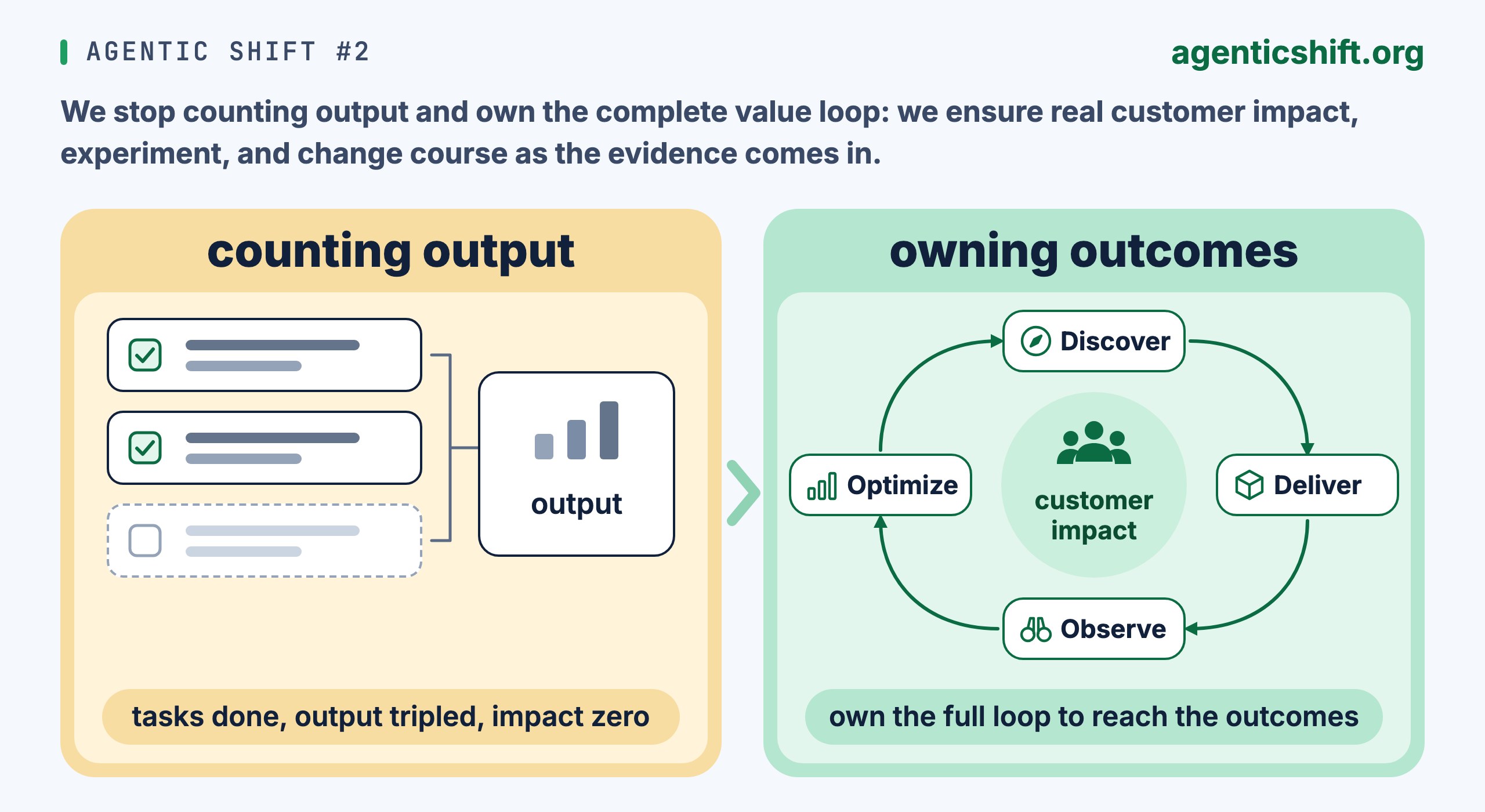 | | Owning outcomes means removing both fences, so the team keeps the whole loop: it discovers what customers need, delivers, observes what actually happened, and optimizes, which includes dropping the idea that didn't work. Only then do outcome metrics make sense. | | Historically, this was a hard sell: making teams own the whole loop, end to end, meant asking a few people to master too many skills and too much of the system. In the agentic age it is becoming more and more feasible, because agents fill the skill gaps and help people learn an unfamiliar part of the system fast. The shift is possible now. Leaders just need to drive it. | | This shift matters not only for the metrics: it is essential for finding a safe place for humans in these changing times. LLMs are, by nature, unaware of where the real value lies, because value is contextual and situational, and finding it takes empathy and exploratory thinking. That is why, as Alexey recently wrote on LinkedIn, pointing AI toward value is the lasting human job, and a team can only do that job when it owns the outcome. | | So look at your teams. Does each of them own a part of the system, or a customer outcome? And what happens when an outcome crosses several teams' territories? Do you add extra roles and processes to manage the dependencies, or even wrap the change in an overcomplicated project management framework? |
|
| |
|
|
| Learn to Lead the Agentic Shift: Next Online Cohort |
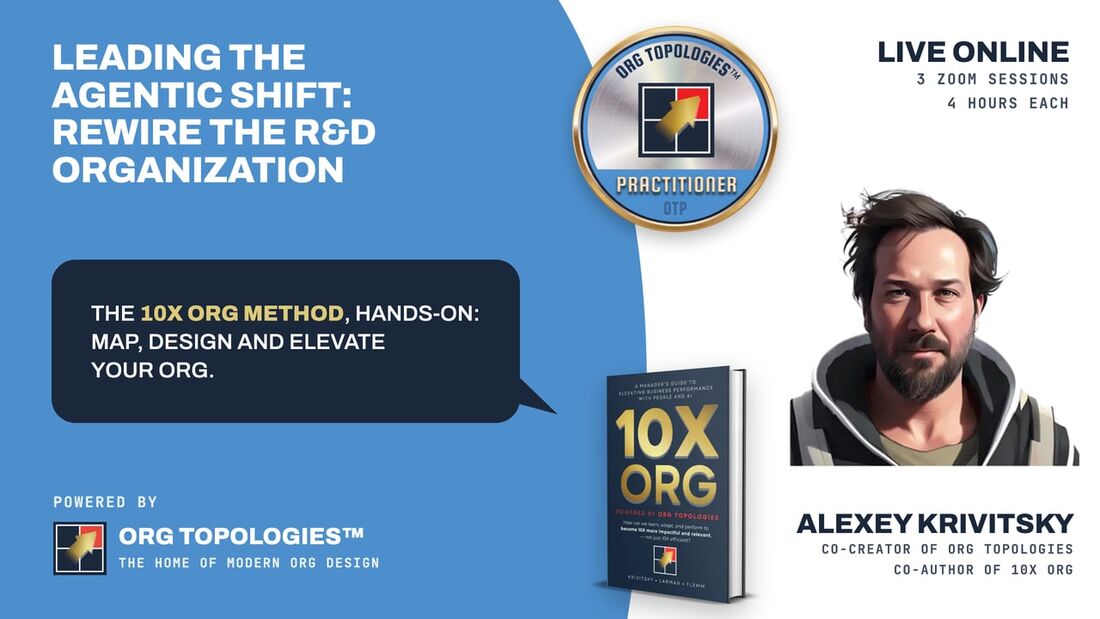
| Leading the Agentic Shift: Rewire the R&D Organization. These practical live sessions are for executives, managers, consultants, and change agents who want to redesign their organization for performance — and then let AI accelerate it. |
 |
| AI doesn't fix a jammed structure. It amplifies whatever is already there. |
| You will learn to: |
| ✓ | Tell the three topologies apart — Resource, Delivery and Adaptive — and understand the dynamics of each | | ✓ | Map your organization using 16 org design archetypes in product development | | ✓ | Apply Strategic AI to accelerate your chosen design, not your current dysfunction |
|
| The class is hands-on: you work on your own organization, not on textbook cases. Three Tuesdays on Zoom, 12, 19 and 26 January 2027, 11:00–15:00 CET, with Alexey Krivitsky. €550, the C-OTP certification fee included. |
|
| 🇺🇦 Цей самий курс також проводиться українською: три середи, 12:00–16:00 за Києвом (11:00–15:00 CET), 21 999 грн. |
| 13, 20, 27 Jan 2027 · Live online · in Ukrainian |
|
|
|
| |
| Elevating SAFe & Spotify Adoptions |
|
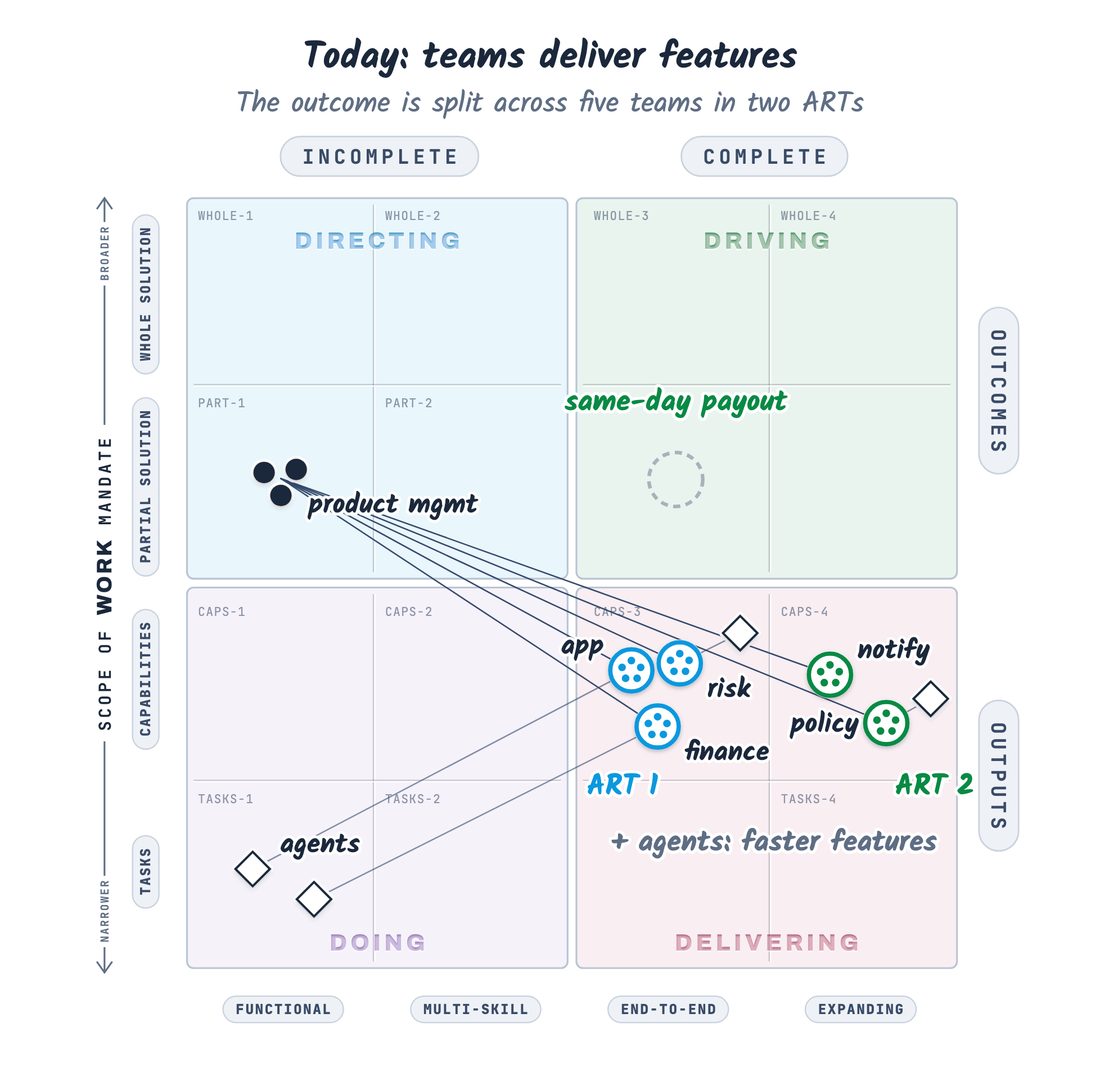
New · 14 Nov 2026 From Features to Outcomes: Where SAFe Teams Belong When Agents Write the Code Agents make SAFe teams faster at features, not outcomes. Map one outcome across your ARTs, find the gap, and elevate an Agile Release Train to own it. |
|
| Building on the broad outcome mandate, let’s look at a typical setup. In many SAFe-like and “McKinsey Spotify” adoptions, teams own an application and deliver features, while the business funds outcomes that often need several teams, sometimes across ARTs and tribes. |
| Historically, this was a common org design choice: teams were slow, and management did not trust them enough to drive outcomes. |
 |
| In November 2026, agentic pipelines can do what pre-AI teams used to do, and faster. So where do people and teams belong now? What we observe across the industry: when team mandates stay the same, most of a team’s “new job” is reviewing what the agents produce (large PRs). Is that the best use of human potential? |
| This article analyzes a classic SAFe adoption (an insurance company case) and shows that when team mandates stay as narrow as before, focused on components, modules or feature sets, the potential gains from AI adoption get lost. |
| The real performance gain is possible. But it will not come from better LLMs, better agentic pipelines or teams learning to trust agent-written code. It will come only from letting people work on the outcomes and find creative ways to reach them with as little output as possible. |
| Read the article → |
| |
|
|
| Bootcamp in Prague: Org Redesign for the Agentic Age |
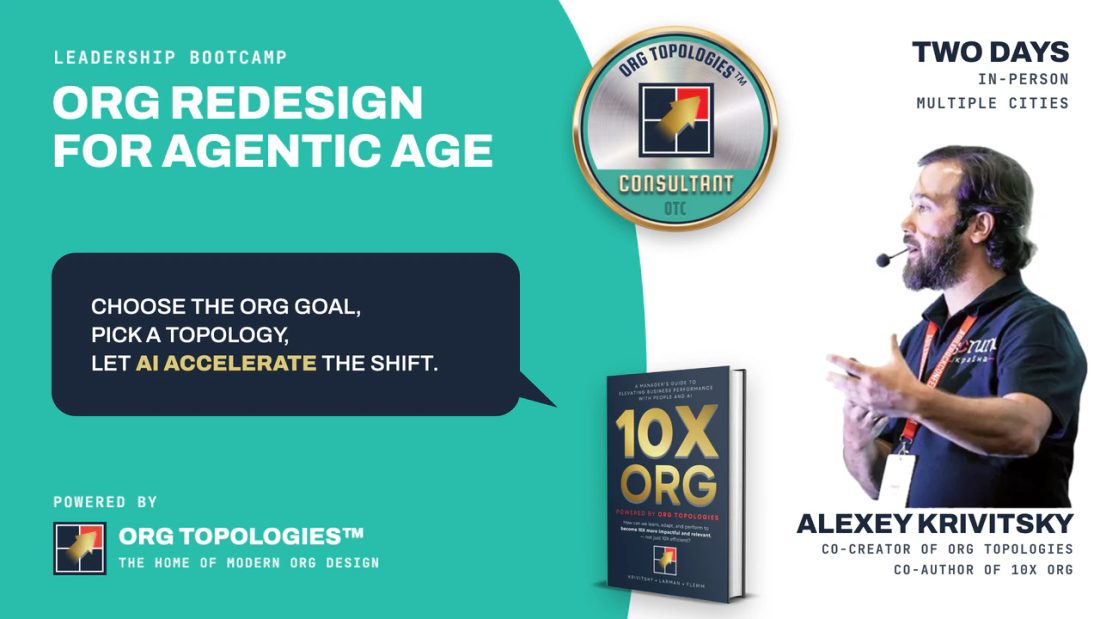
| Org Redesign for the Agentic Age — Leadership Bootcamp. Bring a real organizational challenge, your own or a client’s. Over two days, you map the organization with Org Topologies, find where work gets stuck between teams and departments, and leave with a practical redesign direction and first steps to test it. |
 |
| You will learn to: |
| ✓ | Explain why repeated reorganizations, agile transformations, or AI initiatives fail to stick, and what to do differently | | ✓ | Build an AI-ready vision for your organization and a realistic path toward it | | ✓ | Use AI to broaden skills and mandates, instead of automating today’s constraints |
|
| Two days in person with Alexey Krivitsky. €1,290, including the C-OTC accreditation path. |
| Coming as a team? Team tickets are up to 35% off. |
|
|
| The same bootcamp in 2027: Stockholm 16–17 Feb · Brussels 9–10 Mar · Tokyo 24–26 Mar · Helsinki 20–21 Apr · Hamburg 27–28 Apr · Amsterdam 6–7 Oct. |
|
|
|
| |
|
New · 21 Nov 2026 Org Tube: Curated Talks on Org Design Tired of YouTube guessing what you should watch next? We built a curated YouTube site dedicated to org design and org change. We call it Org Tube: a pre-filtered YouTube for you. Almost 1,500 hand-picked talks, free, no account needed. The filter algorithm learns and improves over time. |
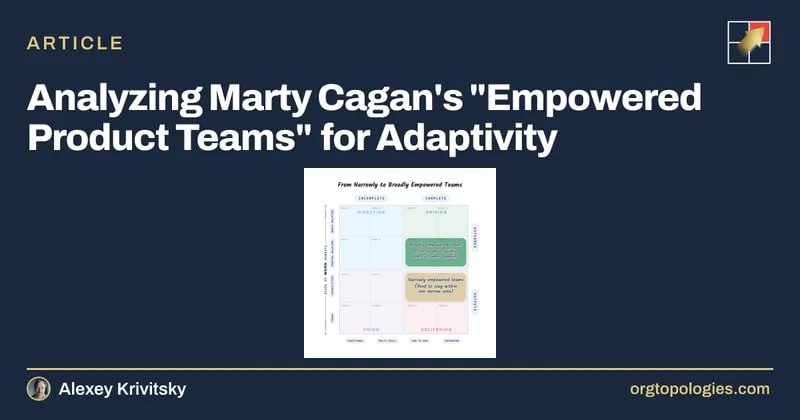
| Revised · 14 Nov 2026 Analyzing Marty Cagan’s “Empowered Product Teams” We revised our 2022 article with this issue’s fresh view on empowerment. Empowered product teams own problems, not features. But a team fixed to one area of the product stays narrowly empowered: it keeps polishing its own corner while the most important problem sits somewhere else. Broad empowerment means a moving focus across the whole customer domain, so people follow the value, learn and deliver. |
|
| |
|
|
| Let’s keep driving the agentic shift with better org design. |
| This newsletter issue was produced for you by Alexey Krivitsky. |
| ORGTOPOLOGIES.COM
© 2026 Org Topologies BV |
|