| Org Topologies™ |
The Org Design Drop
Nov 2026 |
|
| Agentic Shift #1: from narrow specialists to complete craftspeople |
 |
|
| Hi there, |
| I've been to five conferences recently, and I'm at a sixth one right now. What strikes me most is how little we talk about the organizational side: which of our structures, roles and rules have to change for the agentic times. |
| So I'll try to help fill that gap, with what I see from the org design and transformation side. Starting with a short series on the agentic shifts. |
| Leading the Agentic Shift. |
01 |
|
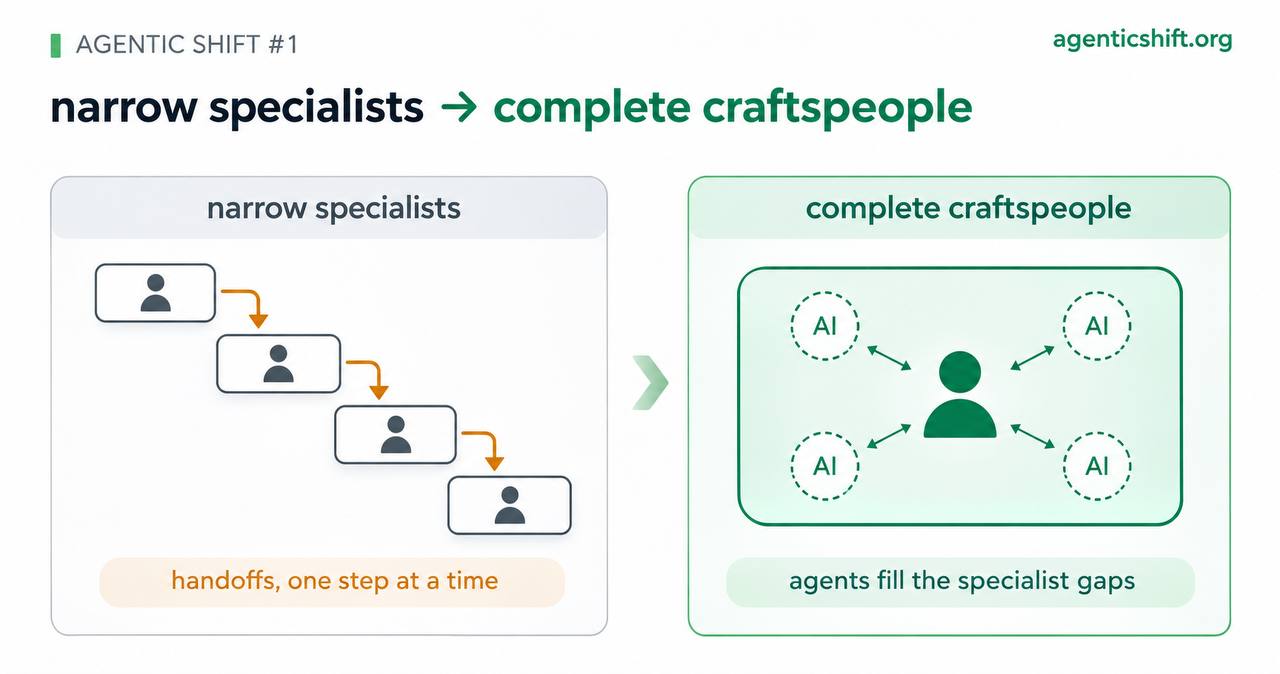 |
| This one feels obvious. With AI at their side, a backend developer can build the UI, write the tests and go through the customer interviews. Agents fill the specialist gaps, and the step into a new domain gets much shorter than it used to be. |
| But the fact that people can work broadly doesn't mean they are allowed to. |
| Look at the job titles. "Senior Java Developer." "Frontend Engineer." "QA Specialist." Each title is a small fence: it says what you own, what you may touch, and what will count at your next review. A Java developer who spends a sprint on the React app and the test pipeline has, on paper, done somebody else's job. And moving to a new domain often resets their seniority. |
| So the organizational side of AI adoption starts in an unglamorous place: career paths. Broader titles first. A Java Developer becomes a Product Developer. Frontend, backend and QA specialists become Product Developers too, with different primary skills. |
| And when a Product Developer L3 is promoted to L4, it's because she grew both deeper and broader. Importantly, not only in technology, but in the customer's domain too. And in the skills this time asks for: AI engineering, orchestrating agents, working directly with customers, business analysis and more. |
| Some companies call this tailwind career paths: the career system pushes people toward the broader work instead of holding them back from it. |
| If your engineers already use AI to cross into new areas, what does their job title still say? Does it support them in doing the whole work, or does it keep them busy using AI to produce more output in their own narrow corner? |
| Learn to Lead the Agentic Shift. |
02 |
|
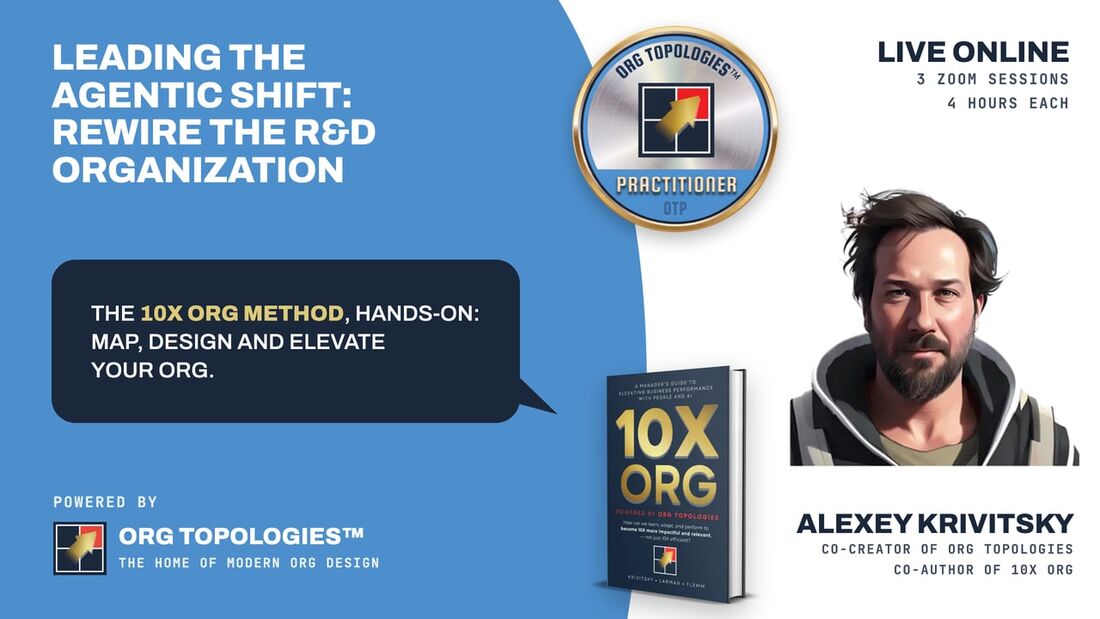
| Leading the Agentic Shift: Rewire the R&D Organization. These practical live sessions are for executives, managers, consultants, and change agents who want to redesign their organization for performance — and then let AI accelerate it. |
 |
| Faster people inside the same structure don't add up to a better business: swap every car on a jammed highway for a Ferrari, and the highway is still jammed. AI doesn't fix that. It amplifies whatever is already there. |
| You will learn to: |
| ✓ | Recognize the four intelligence groups and what separates them | | ✓ | Tell the three topologies apart — Resource, Delivery and Adaptive — and understand the dynamics of each | | ✓ | Map your organization using 16 org design archetypes in product development | | ✓ | Choose the design your strategy needs, instead of copying someone else's model | | ✓ | Run the MADE loop (Map, Assess, Design, Elevate) to improve step by step instead of reorganizing | | ✓ | Apply Strategic AI to accelerate your chosen design, not your current dysfunction |
|
| The class is hands-on: you work on your own organization, not on textbook cases. Three Tuesdays on Zoom, 11:00–15:00 CET, with Alexey Krivitsky. €550, the C-OTP certification fee included. |
| 12, 19, 26 Jan 2027 · Live online |
|
|
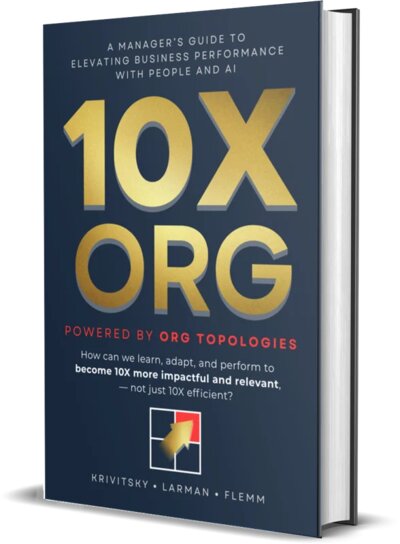
| AI makes people faster. That alone won't keep them in the game: in the AI age their relevance has to grow 10X too, or they won't compete. That is the question behind 10X ORG: how can we learn, adapt and perform to become 10X more impactful and relevant, not just 10X efficient? |
| Craig Larman, co-author of 10X ORG, on why this book matters: |
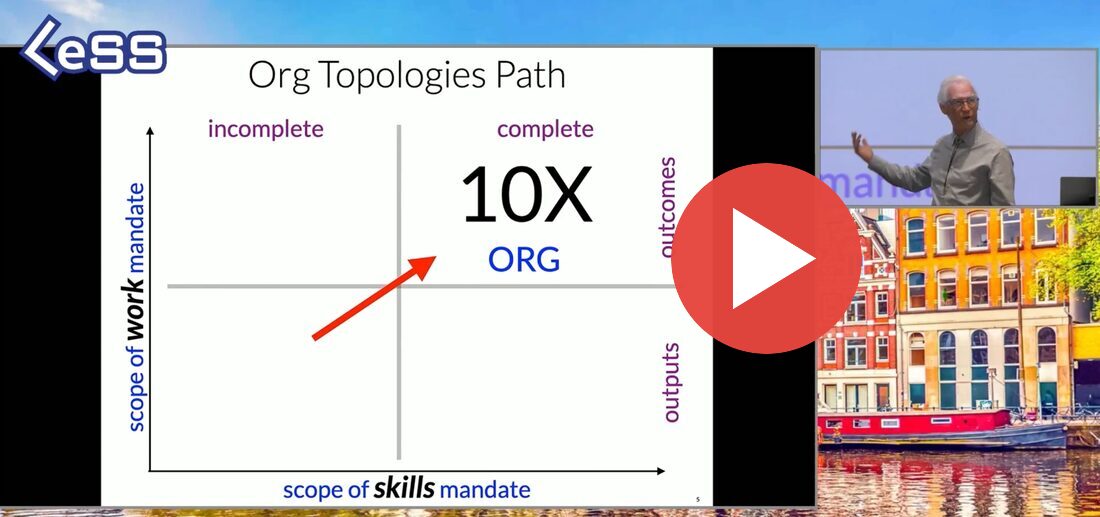 |
| Watch Craig Larman on 10X ORG → |
The book
10X ORG
“10X is a vote for humanity in an era obsessed with mechanical efficiency.”
By Alexey Krivitsky, Craig Larman and Roland Flemm: a business novel with a working method for strategic org design with people and AI.
|
|
| Upcoming in-person classes. |
04 |
|
C-OTC Bootcamp · Hamburg 7–8 Dec 2026 Bring a real case, map it with Org Topologies, and leave with a practical redesign direction and first steps to test it, so AI's speed turns into business results. |
| C-OTC Bootcamp · Prague 17–18 Dec 2026 A two-day, in-person bootcamp for consultants and leaders who redesign organizations. Includes the path to C-OTC accreditation. |
| C-OTC Bootcamp · Stockholm 16–17 Feb 2027 A two-day, in-person bootcamp for consultants and leaders who redesign organizations. Includes the path to C-OTC accreditation. |
| C-OTC Bootcamp · Brussels · Tokyo 9–10 Mar 2027 · 24–26 Mar 2027 The same bootcamp in Brussels, and in Tokyo over three days. |
| Org Design Summit 2027 · Amsterdam 8–9 Oct 2027 Two days in Amsterdam. |
|
|
|
| Questions, or a story from your own org? Just hit reply. |
See you soon ✌️
Alexey Krivitsky & Roland Flemm |
| ORGTOPOLOGIES.COM
© 2026 Org Topologies BV |