Banking
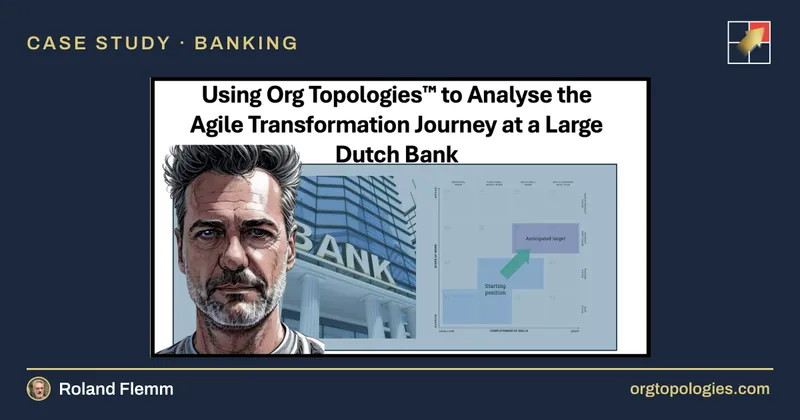
Case Study: Using Org Topologies™ to Analyze the Agile Transformation Journey at a Large Dutch Bank

MADE · STEP 3 · DESIGN
The Design step starts with the question: What should this organization be optimizing for, and which strategic capabilities does it need to develop in order to better serve its future?
From 10X ORG · Principle 5: Change Through a Learning Loop
FROM 10X ORG · PRINCIPLE 5: CHANGE THROUGH A LEARNING LOOP
Strategy needs a vehicle to translate intent into performance—and that vehicle is the organization.
Thinking of an organization as a vehicle helps. When choosing a car, we clarify what matters most: speed, capacity, safety, or flexibility. A sports car, a freight truck, and an SUV are all well-designed, but for different purposes. No single vehicle excels at everything.
The metaphor breaks down, however, because in real organizational design work, we almost never get a clean showroom choice. Leaders redesign while already in motion—from a messy state.
They inherit structures, people, habits, customers, commitments, codebases, budgets, and policies—and must refactor while the business continues to run. In this reality, change rarely follows a straight line from objectives to design choices to performance gains.
When leaders do try to design more strategically, they often reach for off-the-shelf models. But what worked elsewhere rarely fits this organization’s constraints, history, and work, even within the same industry.
Organizational redesign is not about drawing an ideal diagram on a blank whiteboard.
FROM 10X ORG · CHAPTER 7: DESIGN FOR THE FUTURE
After the group reviewed the business landscape, the consultant invited them to identify what they wanted strengthened in the organization to increase the likelihood of success. He displayed ten potential “organizational goals”—as he called them—on the screen:
Output Predictability
delivering consistently and reliably.
Lead Times & Throughput
reducing waste, delays, improving flow.
Specialist Expertise
maintaining deep skill and craft where it counts.
Customer Value
delivering outcomes that truly matter to users.
Adaptiveness
responding flexibly to change.
Employee Engagement
sustaining motivation and satisfaction.
Operational Reliability
ensuring stable day-to-day operations.
Ideation and Innovation
generating and testing new ideas.
Organizational Learning
continuously learning and improving.
Resource Efficiency
using resources wisely, without excess.
10X ORG · CHAPTER 7 · QUESTIONS FOR SLOW THINKING
If you were to reimagine your organization based on what it needs to become to be the best version of itself and to drive the strategy well, which one or two organizational goals would you pick from the list?
ACADEMY
Learn the Org Topologies approach
Practitioner (C-OTP) and Consultant (C-OTC) classes, live online and in person.
FROM 10X ORG · PRINCIPLE 7: MAKE THE ORG GOAL WIN
“Organizations are implicitly optimized to avoid changing the status quo of middle- and first-level manager and ‘specialist’ positions & power structures.”
The root cause behind failed organizational change is rarely motivation or competence; it is misalignment. It is surprisingly rare for an organization to clearly declare a single primary optimizing goal. Without that clarity, different parts of the organization pull in different directions, each optimizing for what their local system rewards.
Consider a shift toward greater customer centricity as an example of a carefully chosen organizational goal.
Top-down, the case looks solid: executives and consultants, viewing the organization as a whole, can clearly see how closer customer proximity would improve outcomes, learning, and long-term performance.
“Yes, I value customer centricity, but if we let developers talk to customers, they’ll have less time to do what they were hired for—development. That would be inefficient.”
Formulating these options as a choice creates a false dilemma. It makes them seem to sit at opposite ends of a spectrum. And as if choosing one necessarily requires sacrificing the other.
Middle managers and specialists are not resisting change out of stubbornness; they are responding rationally to the system they operate in.
We all optimize within the scope of what we own—the scope by which our performance is judged. And we don’t want to fail. What is interesting is that we might not even be aware of the false choices we create.
But what is being efficient, really?
When we look at the three Org Topologies side by side, the difference becomes explicit:
Resource Topology
“Efficiency” means maximum productive utilization of specialized skills with minimal idle capacity.
Delivery Topology
“Efficiency” means fast, reliable end-to-end flow of known work from demand to delivery.
Adaptive Topology
“Efficiency” means lowering the cost of learning, reconfiguration, and redirection.
So when someone argues for making things “efficient,” or uses words like “faster,” “slower,” “cheaper,” or “more expensive” to justify what should be optimized, be cautious.
Ask what they mean, really—local or global speed? Short-term or long-term costs? Efficient for whom? Against which goal?
In too many cases, these questions are not asked, hiding unspoken assumptions.
#1: How do we optimize for customer centricity with its promising business benefits, #2: while also allowing our engineers to work with flow and have enough focused time?
Notice the two parts of this exploratory, open-ended question.
Primary concern
The first part of the question is our primary concern—we want to optimize it for some greater good. This is usually the chosen organizational goal with a broad and positive global impact.
Secondary concern
The second part of the question is the secondary concern—something that we value, do not want to lose, diminish, or jeopardize during the change process. We will do our best to work on it, but only to the extent that it does not undermine our primary concern.
So, first things first.
This reframing allows us to find a dozen new, vivid solutions we couldn’t see before when the choice was viewed in black and white. They only become visible once we start asking better questions.
The field of possibilities is endless when you go from “either-or” to “both-and”.
Without an explicit primary goal, everyone fills in the blanks themselves. Each manager and employee defines “efficiency” for themselves from their local perspective and then acts accordingly.
When the org goal is unclear or weakly embedded, “efficiency” becomes a battlefield, and local optimization quietly defeats the intended direction.
Making the org goal win requires explicitly choosing a primary organizational goal, accepting the trade-offs that come with it, and embedding that choice into structure, mandates, incentives, and decisions.
Therefore:
FROM 10X ORG · PRINCIPLE 4: FIT FOR PURPOSE
We must repeat: no organizational topology is “better” in and of itself. As Structural Contingency Theory established decades ago, there is "no one best way" to organize; there is only the way that fits your purpose.
Doing + Directing
Delivering + Directing
Driving
FROM 10X ORG · PRINCIPLE 4: FIT FOR PURPOSE
When applied to Product R&D, the forces behind Resource Topology often lead to rigid ownership of subsystems by individual teams. This pattern is well studied and documented under the names: Component Development or more specifically Component Teams Dynamic.
This approach comes from a traditional way of organizing the work of large software product groups, where developer teams form around architectural modules. Customer-facing features are then decomposed so that each team delivers only the piece related to its component.
Moreover—and this is fascinating—the teams might even think they have no dependencies on each other. How come? Whatever work they see has already been prefiltered to match their skill and work scope.
But that’s a very local lens. Performance has to be judged at the outcome level—on what customers value and what the business needs—not on how neatly each unit works within its silo.
When work is split into components and ownership is fragmented, progress naturally becomes sequential. Each team optimizes its part, hands work over to the next, and waits. Feedback arrives late, learning is delayed, and iteration collapses into a rigid stage-gate process.
To improve global performance, R&D teams must be unpinned from owning components large and small: applications, subsystems, services, and modules. Their mandates have to shift to delivering end-to-end customer features.
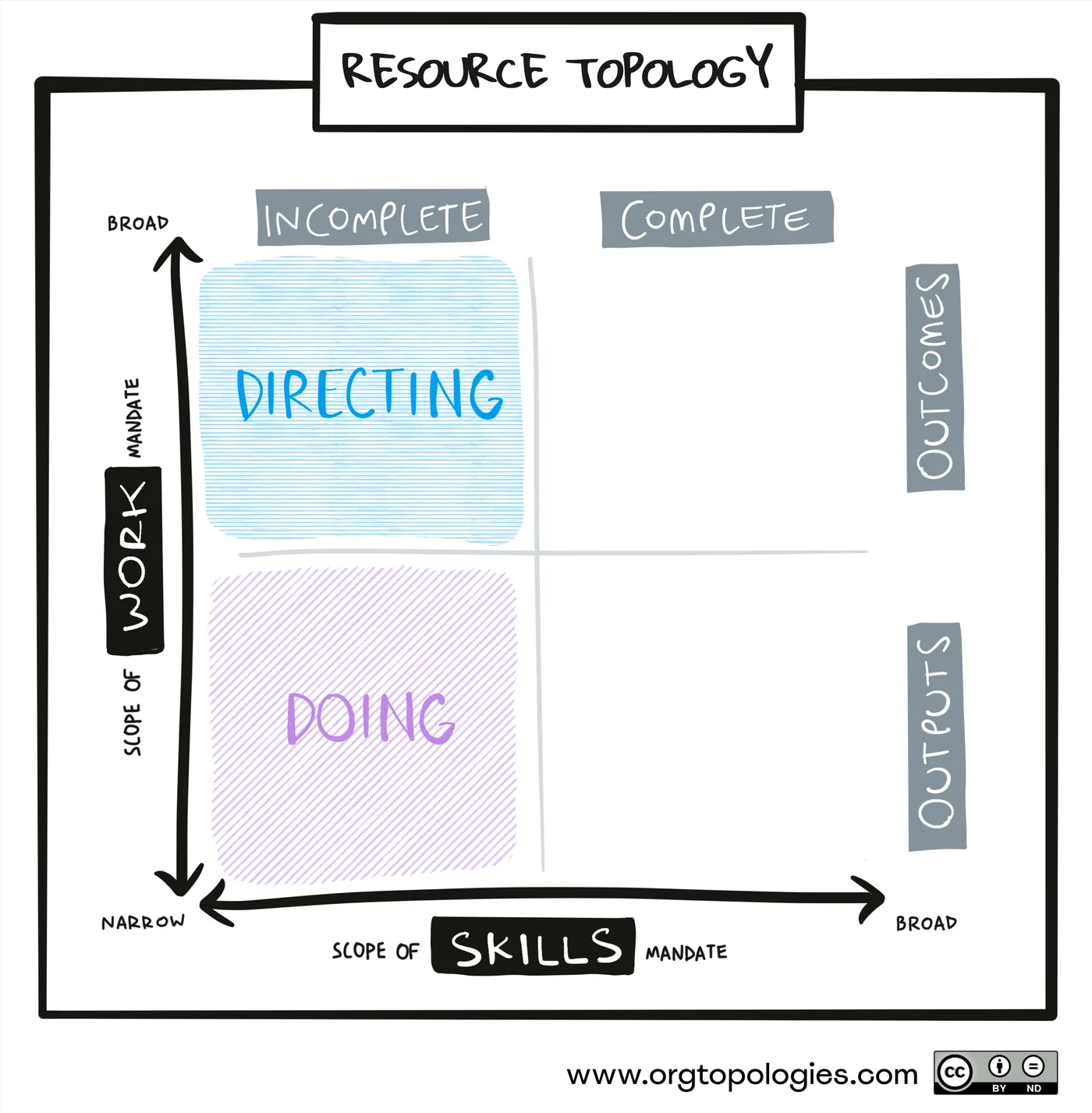
Waterfall is not a mindset problem; it is a structural outcome.
FROM 10X ORG · PRINCIPLE 4: FIT FOR PURPOSE
Delivering value fast and with flow sounds like honey to most executives’ ears. But “fast” and “flow” mean very different things depending on the nature of work.
If some work—service delivery or product development—can truly be done by a single team with good flow, there is little else to wish for. Provided, of course, that the direction of the team’s fast running is right.
The problems begin when the work is truly larger than any team’s scope.
This is the trade-off built into the heart of Delivery Topology. It is optimized for local speed and local flow, because it promises speed and flow only in isolation—by splitting a whole into parts and assigning those parts to teams. The moment an outcome requires coordinated change across many parts, local speed and flow do not translate into global speed and flow.
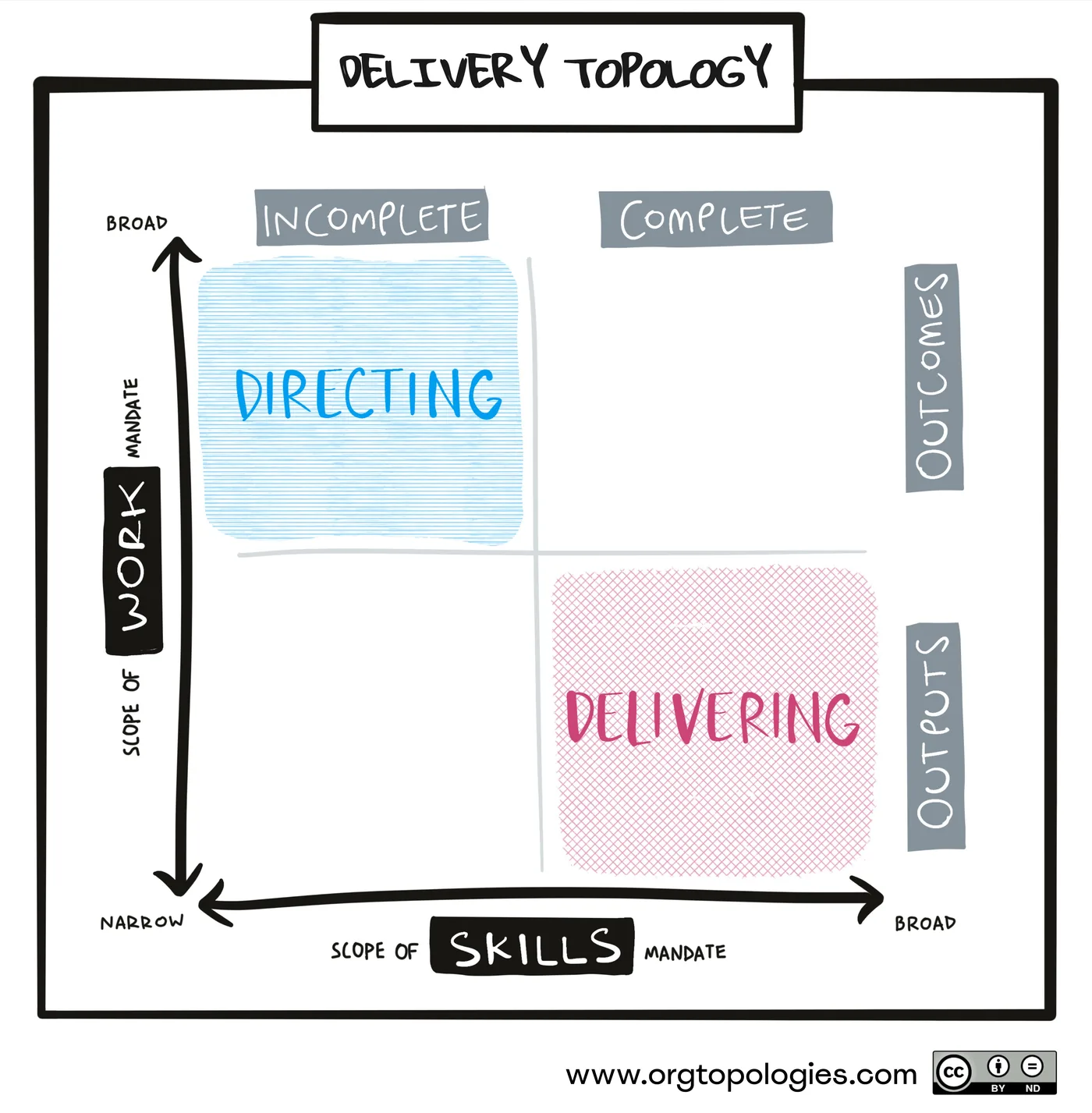
So next time you promise speed and flow to stakeholders—or if you are a stakeholder being promised that—slow down and go one level deeper: are we talking about local speed or global speed, short-term flow or long-term flow?
FROM 10X ORG · PRINCIPLE 4: FIT FOR PURPOSE
There is something deeply attractive about the idea of a single topology spanning the entire organization. Perfect alignment. One logic. One rhythm. One way of working.
In reality, that level of uniformity is not always feasible. Sometimes the organization is too large. Sometimes it is improving incrementally, constrained by history, contracts, or risk. And sometimes different parts of the business are doing fundamentally different kinds of work. In those cases, multiple topologies will have to coexist.
That is what purposeful organizational design looks like in practice. Leaders must be explicit about what each part of the organization is optimizing for—and accept that different kinds of work call for different topologies.
Self-Sufficiency
Making multiple topologies coexist in a synergistic way requires clear guidelines. One key rule is self-sufficiency. For a topology to optimize what it is meant to optimize, it must stand largely on its own—a business within the business.
Clear Accountability
Clear accountability matters. Each topology needs ownership of outcomes. In practice, this means treating topologies as profit centers wherever possible—containing the relevant costs, investments, and trade-offs within the same structural boundary. Only then can they optimize coherently, without pushing complexity onto the rest of the system.
Must Not Be Static
Multi-topology setups must not be static. As strategy or the environment shifts, topologies must evolve with them. Freezing a topology turns today’s fit into tomorrow’s constraint.
FROM THE CASE STUDIES
FROM 10X ORG · PRINCIPLE 2: DRIVE PERFORMANCE WITH ORG DESIGN
Jay Galbraith’s Star Model™ offers the most valuable lens. It teaches us that an organization is not just its org chart or sum of all policies, but a system of interconnected design choices that must be made deliberately and kept in sync.
This model represents the core organizational design elements that must be aligned for the organization to deliver on its strategy:
Org Design Criteria
The outcomes the organization is designed to achieve are derived from the strategy and are used as the benchmark for all design choices.
Structure
How power and authority are distributed: roles, units, reporting lines, and the basic architecture of who reports to whom.
Processes
How work and information flow: governance routines, planning and budgeting cycles, and decision-making processes.
Rewards
How people are motivated and steered: compensation, promotions, recognition, and other formal and informal incentives.
People
The skills, mindsets, and capacities needed: how the organization recruits, develops, and grows people to match its strategic needs.
When they are aligned and reinforce one another, performance becomes more reliable and less accidental.
FROM 10X ORG · PRINCIPLE 3: SHAPE INTELLIGENCE WITH MANDATES
In the OT language, every organizational unit carries a mandate: a bundle of authority and responsibility to decide, explore, act, and deliver results within a defined scope.
Imagine a service-desk team in a large service organization. They answer calls, log issues, and forward requests to other departments. But can they resolve a customer’s billing problem end-to-end? Not really. They are incomplete by design; they do not have the mandate to deliver a full resolution.
Now, picture a full-service team that owns the entire customer experience. They can investigate the issue, update the billing record, adjust the contract when needed, and confirm with the customer that everything is resolved. They have the tools, the data, and the authority to act. That team is complete.
Incomplete doesn’t mean “bad.” But it does mean insufficient and interdependent, as seen through the customer’s eyes.
Incomplete units can serve a purpose: tightening security, enforcing control, reducing costs, or preserving rare specialization. They can also preserve long-standing, outdated organizational habits.
This distinction is crucial because most dependencies are structural and can’t be solved by an extra “alignment meeting” or a “big room” planning session.
FROM 10X ORG · PRINCIPLE 6: FOLLOW THE VALUE—LEARN AND DELIVER
The industry is full of best practices for slicing organizations into parts.
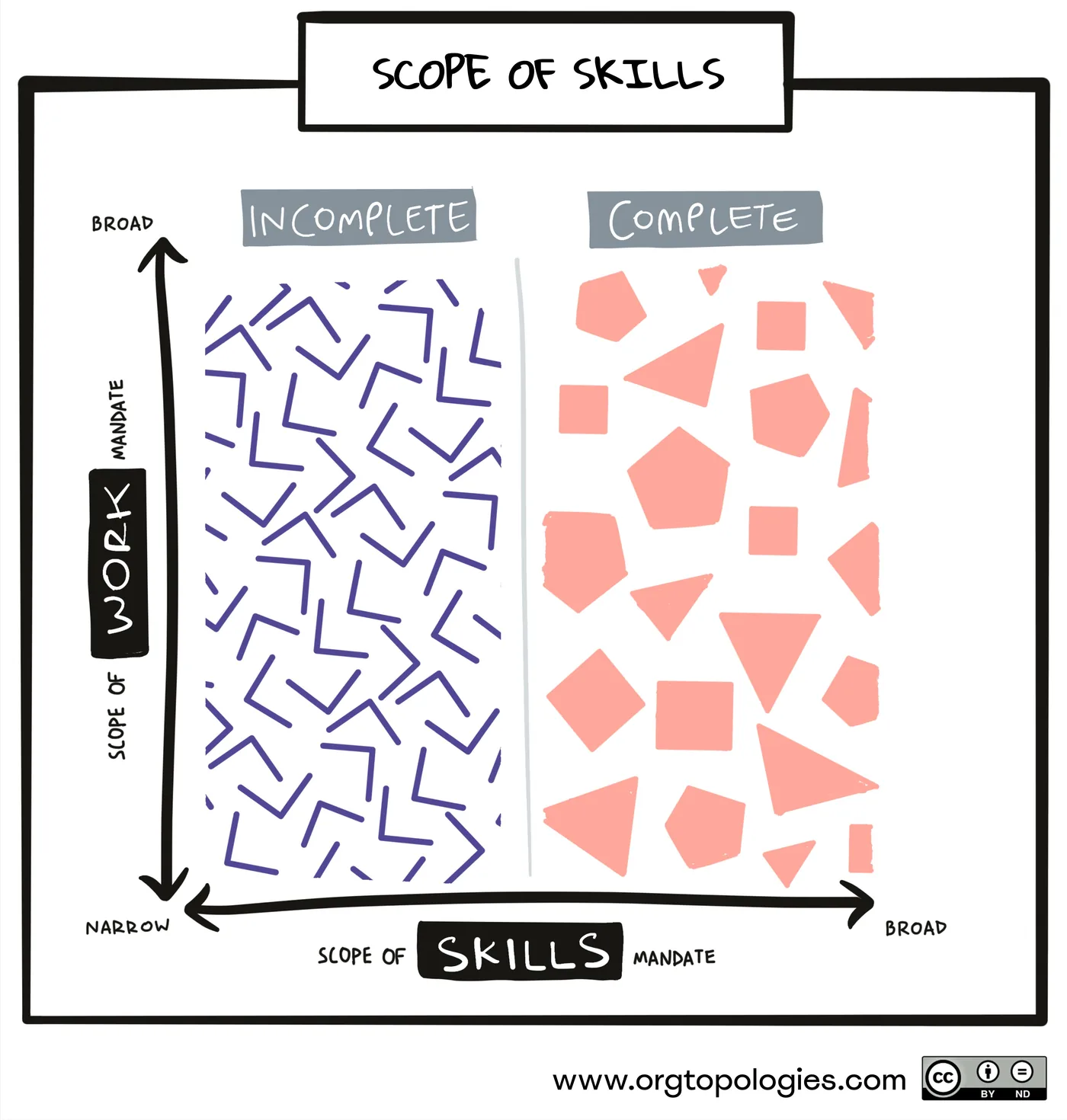
Each unit combines fewer skills and owns a smaller slice of work. The promise is clear accountability within well-defined boundaries for speed: less to care about, less to learn, and fewer distractions. And locally, this works. Teams become very good at executing their part.
But how long does that fit last?
But in a dynamic environment, the narrower the team’s scope, the higher the likelihood that the design will drift out of fit. As work shifts, narrowly scoped teams struggle to respond. Employees and managers might see what needs to be done, but are structurally prevented from acting on it.
The root cause of repeated reorganizations is the inability of organizational units to remain relevant as work shifts. In Resource and Delivery topologies, work is analyzed, decomposed into smaller pieces (streams, features, or tasks), and assigned to organizational units designed to execute that specific type of work. In such setups, work follows workers.
We propose reversing that logic.
When organizations are designed with broader mandates, individuals and teams can take responsibility for larger, unsliced outcomes. Following the value then means learning and delivering what matters most.
This ability to follow value into the unknown, learn there, and still deliver is what creates true adaptive capability. It allows the organization to respond, recombine, and evolve as conditions change—without repeatedly reshuffling its structure to catch up.
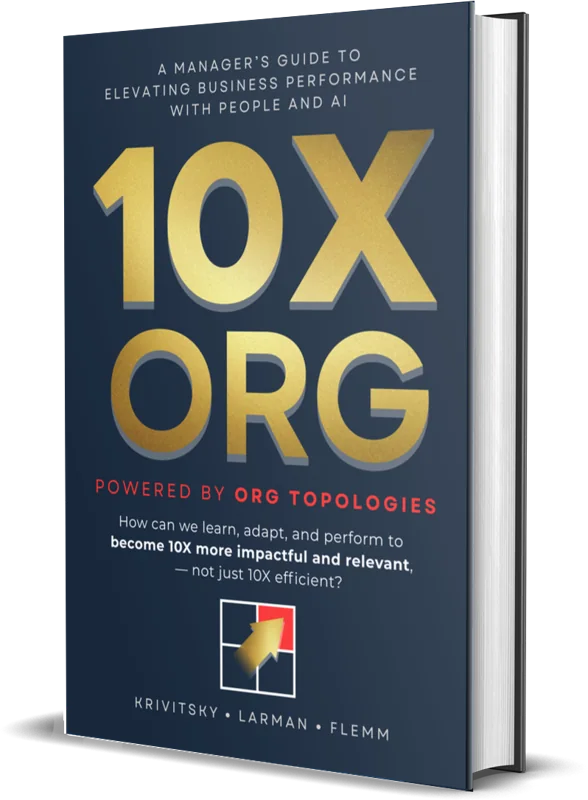
THE BOOK · POWERED BY ORG TOPOLOGIES
10X is not more activity. It is a tenfold increase in the organization's capability to learn, evolve, create value and stay strategically aligned.
#1 Best Seller in Business Management, Management Science and Strategic Management
More About the Book →Paperback: Amazon .com (Amazon, opens in a new tab) · .de (Amazon, opens in a new tab) · .fr (Amazon, opens in a new tab) · .nl (Amazon, opens in a new tab) — eBook: Leanpub (opens in a new tab) (PDF, EPUB and web)
“10X is a vote for humanity in an era obsessed with mechanical efficiency.”
“You might be surprised how disconnected your organization’s structure is from what you are trying to achieve with it. This book describes a practical approach to organizational redesign, offering a blueprint for success.”
 Dave WestCEO of Scrum.org (2015–2026)
“Org Topologies forces an honest look at how the organization truly works, not how the slide decks pretend it works. … What follows is the real magic: defensiveness drops, curiosity kicks in, and the conversation switches from protecting the past to shaping a structure that actually makes sense for the future. OT does what a thousand slide decks never will: it forces clarity, fast. … Most management books add complexity. This one strips it away.”
 Jurgen De SmetYour Chief Simplification Officer (Belgium)★★★★★ on Goodreads
“Absolutely one of the best books in recent years—and certainly the best at explaining how to get the maximum possible value out of AI. … We purchased the book for our entire executive team, along with 10 additional copies to circulate among others.”
“The book’s core insight is clear: true 10X growth requires rethinking organisational structure—not just adding technology to existing silos. If you want real organisational improvement—not just theatre—read it to understand why fluid scaling and self-organisation are the key building blocks for 10X change.”
 Quinton QuartelCreator of FAST Agile (USA)
“Despite being written for the context of 2026, the book is a heavyweight packed with timeless organizational wisdom. My highlighter literally ran out of ink trying to mark all the nuggets for future educational use.”
 Steinar HaldorsenStrategic Executive Partner (Norway)★★★★★ on Goodreads
“A rare book that actually changes how you see organizations. … If you've ever sat through a reorg that solved nothing, or watched an 'AI transformation' stall because nobody addressed the underlying structure — this book names what you were feeling and gives you a vocabulary to act on it.”
“As someone who lives in the world of Flow, Kanban Strategy, TameFlow, and Org Design, this is the book I've been waiting for.”
 José CoignardProKanban Trainer (France)★★★★★ on Goodreads
“The core contribution of the book is simple but powerful: performance is structural. … What I appreciate most in the book is that it treats organizational design not as a consultant deliverable, but as a leadership responsibility!”
“For me, the Org Topologies concept brought new light and joy into scaling conversations, and I would highly recommend it for any organization, no matter how far they are on their agile journey.”
 Zuzi ŠochováCertified Scrum Trainer; author of The Great ScrumMaster (Czech Republic)
“In a way, reading 10xOrg feels like revisiting Peter Senge's The Fifth Discipline in the Age of AI.”
“Packed with practical tips that help me reflect and act in my role as a leader. This is a book you should always have in your back pocket!”
 Joris VerheijDirector Anti-Financial Crime Operations, ASN Bank (Netherlands)
“10X Org is one of the few org/design books I've read that genuinely integrates systems thinking, orgl design and AI leverage in a coherent way.”
 Alena Hlekava★★★★★ on Goodreads
“The characters feel so real that I kept thinking: "Yep, I've worked with this person." … For me, the storyline made the ideas stick.”
“OT gave me the insight that growing companies suffer from a growing need for coordination … The Team-of-Teams, guided by a common vision and goal, requires less top-down coordination.”
 Michiel de van der SchuerenDigital transformation lead, public sector, Rapid Circle (Netherlands)
“With all the hype around AI, I was getting anxious about my future as a developer. This book helped me change my perspective and understand how to steer my career to remain productive and valuable in my organization.”
“As someone who has worked for years with organizational design and large-scale agile transformations, I rarely get genuinely excited about a management book. 10x Org is one of those rare exceptions.”
 Robert BrieseExecutive Agile Coach, Certified LeSS Trainer (Germany)★★★★★ on Amazon.de
“I particularly liked the “Ferrari Effect” metaphor: AI can make individuals faster, but if the organisation still has traffic jams and roadblocks, overall performance will not improve.”
“For me, Org Topologies™ has become the missing piece of the puzzle that connects agility, frameworks, switching costs, transaction costs, learning costs, to organizational design.”
 Koen Siegers★★★★★ on Amazon.com
“This book goes straight to the heart of the issue: the real bottleneck is rarely the technology — it’s the organizational design.”
“Good managers understand the relationship between organisational performance and how work and skills are structured. Great managers apply this in practice.”
“A dialogue-based book that you finish thinking "okay, now I see it." A really necessary book for managers.”
“A powerful and practical guide for modern leaders. Clear thinking, actionable frameworks, and a compelling vision for combining people and AI to elevate performance. Highly recommended.”
“The exchange between novel and narrative, and explanation of how they helped organisations based on real life experience and examples, is a refreshing way of storytelling as well as educating. A pleasant yet educative read!”
“If you’re wondering what your organization is actually optimizing for, read the book!”
 Julius Alexander Friedrichon LinkedIn
ACADEMY
All upcoming events
 10–24 Nov 2026OnlineOnline Class – Leading the Agentic Shift: Rewire the R&D Organization
 €550 excl. VATLearn moreThese practical live sessions are for executives, managers, consultants and change agents who want to redesign their organization for performance — and then let AI accelerate it.
 17–18 Dec 2026PragueBootcamp – Org Redesign for Agentic Agefrom €1,290 excl. VATLearn moreA two-day, in-person bootcamp for consultants and leaders who redesign organizations. Bring a real case, map it with Org Topologies, and leave with a practical redesign direction and first steps to test it, so AI's speed turns into business results. Includes the path to C-OTC accreditation.
 12–26 Jan 2027OnlineOnline Class – Leading the Agentic Shift: Rewire the R&D Organization€550 excl. VATLearn moreThese practical live sessions are for executives, managers, consultants and change agents who want to redesign their organization for performance — and then let AI accelerate it.