
MADE · STEP 2 · ASSESS
Three topologies.
Choose your org goal.
A topology is a recognizable pattern of where an organization's units sit on the map. Each one is optimized for something — and pays for it somewhere else. None is “best”. The question is whether it fits your purpose and your environment.
ACADEMY
Learn the Org Topologies approach
Practitioner (C-OTP) and Consultant (C-OTC) classes, live online and in person.
TOPOLOGIES AT A GLANCE
Fit for purpose
FROM 10X ORG · PRINCIPLE 4
No organizational topology is “better” in and of itself. There is “no one best way” to organize; there is only the way that fits your purpose.
Leaders must decide what they are optimizing for. That decision requires accountability, not consensus. It implies consciously accepting what they are not optimizing for. Trade-offs are unavoidable: no organization can optimize for everything at once.
Choosing among the topologies, or deliberately combining them for different goals, is the core practice of organizational design. It determines what kind of performance the organization can reliably produce.
THE KEY QUESTION
Which organizational capabilities will effectively support our strategy?
Are you trying to get better at:
| RESOURCE | DELIVERY | ADAPTIVE | |
|---|---|---|---|
| Maximizes | Resource use, specialization | Output, predictability | Outcome, innovation |
| Dependencies | High | Moderate | Low |
| Best environment | Stable, repeatable demand | Known demand, stable roadmap | Uncertain, fast-changing markets |
- RESOURCE
- Maximizes
- Resource use, specialization
- Dependencies
- High
- Best environment
- Stable, repeatable demand
- DELIVERY
- Maximizes
- Output, predictability
- Dependencies
- Moderate
- Best environment
- Known demand, stable roadmap
- ADAPTIVE
- Maximizes
- Outcome, innovation
- Dependencies
- Low
- Best environment
- Uncertain, fast-changing markets
Different parts of one company can run different topologies — a legacy service in Delivery, a new venture in Adaptive. What matters is that each part's design serves its goal.
SAMPLE MAPPING
01 · DIRECTING + DOING
Resource Topology
Org goal: maximize efficiency of specialized skills under stable demand.
“THE MECHANISTIC SYSTEM” — precision through specialization
Dynamics
Directing units plan, split and dispatch work. Specialists in functional groups each do one part. Specs, hand-offs and coordination connect the pieces; upfront planning and re-planning keep it moving.
At a glance
- Common use case
- PMO resource management of specialists
- Value creation
- Fragmented and reliant on multiple handoffs and coordination
- Dependencies
- High; units depend on coordination across functional silos
- Group structure
- Siloed functional groups with specialized roles
- Empowerment
- Low; constrained to predefined tasks with little autonomy
- Individual contributors
- Complete isolated tasks (defined by coordinators) using specific skills, with minimal ownership
- Strategic AI
- Automates repetitive tasks, optimizes workflows, enhances resource efficiency
- Example
- A movie producer hiring dancers for a scene
Typical contexts: shared services, payroll, compliance, commodity manufacturing, long-lived platforms.
With AI: AI automates specialized tasks fast — narrow specialist roles face displacement unless mandates widen.
SAMPLE MAPPING
02 · DIRECTING + DELIVERING
Delivery Topology
Org goal: maximize end-to-end flow of predictable work from demand to delivery.
“THE STRUCTURED NETWORK” — optimized for flow
Dynamics
Complete cross-functional teams deliver within fixed, narrow value boundaries. Discovery stays separate, with directing units deciding what to build. Fast and efficient at outputs — sometimes called a “feature factory”.
At a glance
- Common use case
- Fast delivery of proven worth with minimal change or learning
- Value creation
- Narrowly focused on specific capabilities
- Dependencies
- Moderate; units coordinate across boundaries but less frequently
- Group structure
- Cross-functional and aligned with narrow product or service features
- Empowerment
- Moderate; empowered within a small home unit but dependent on alignment between units, managed by Directing units
- Individual contributors
- Coordinate to deliver features and components within the team’s scope
- Strategic AI
- Integrates data, improves collaboration, aligns team outputs through real-time insights and feedback loops
- Example
- A diner with short-order cooks: the owner decides the menu, the cooks deliver complete plates
Typical contexts: established products with known demand, SaaS in growth or maturity, managed services, customer support.
With AI: AI absorbs execution work faster than teams can adapt their skills and mandates.
SAMPLE MAPPING
03 · DRIVING
Adaptive Topology
Org goal: minimize the cost of learning and reconfiguration in volatile environments.
“THE LIVING ECOSYSTEM” — co-evolving with its environment
Dynamics
Directing, doing and delivering merge into one team-of-teams — people and AI agents — with a broad shared mandate. Work is synchronous and coordinated by those doing it; learning runs across skills and across the scope of work.
At a glance
- Common use case
- Fast delivery of uncertain results, to seek, change, discover and adapt
- Value creation
- Flexible, holistic and novel
- Dependencies
- Low; units work autonomously with minimal dependency on external groups
- Group structure
- Multi-skilled and organized for exploratory outcomes and flexibility
- Empowerment
- High; owns entire processes including inter-unit coordination
- Individual contributors
- Collaborate across boundaries to deliver complete customer solutions, with end-to-end ownership
- Strategic AI
- Drives innovation, predicts customer needs, supports strategic decision-making
- Example
- Units working across the entire solution space (“Uber”) or a partial domain (“Uber Eats”)
Typical contexts: new product development, innovation, platform exploration, consulting, research, emerging services.
With AI: AI as teacher and sparring partner lowers the cost of switching domains — and makes this design easier to reach.
THE APPROACH
Change, MADE systemic
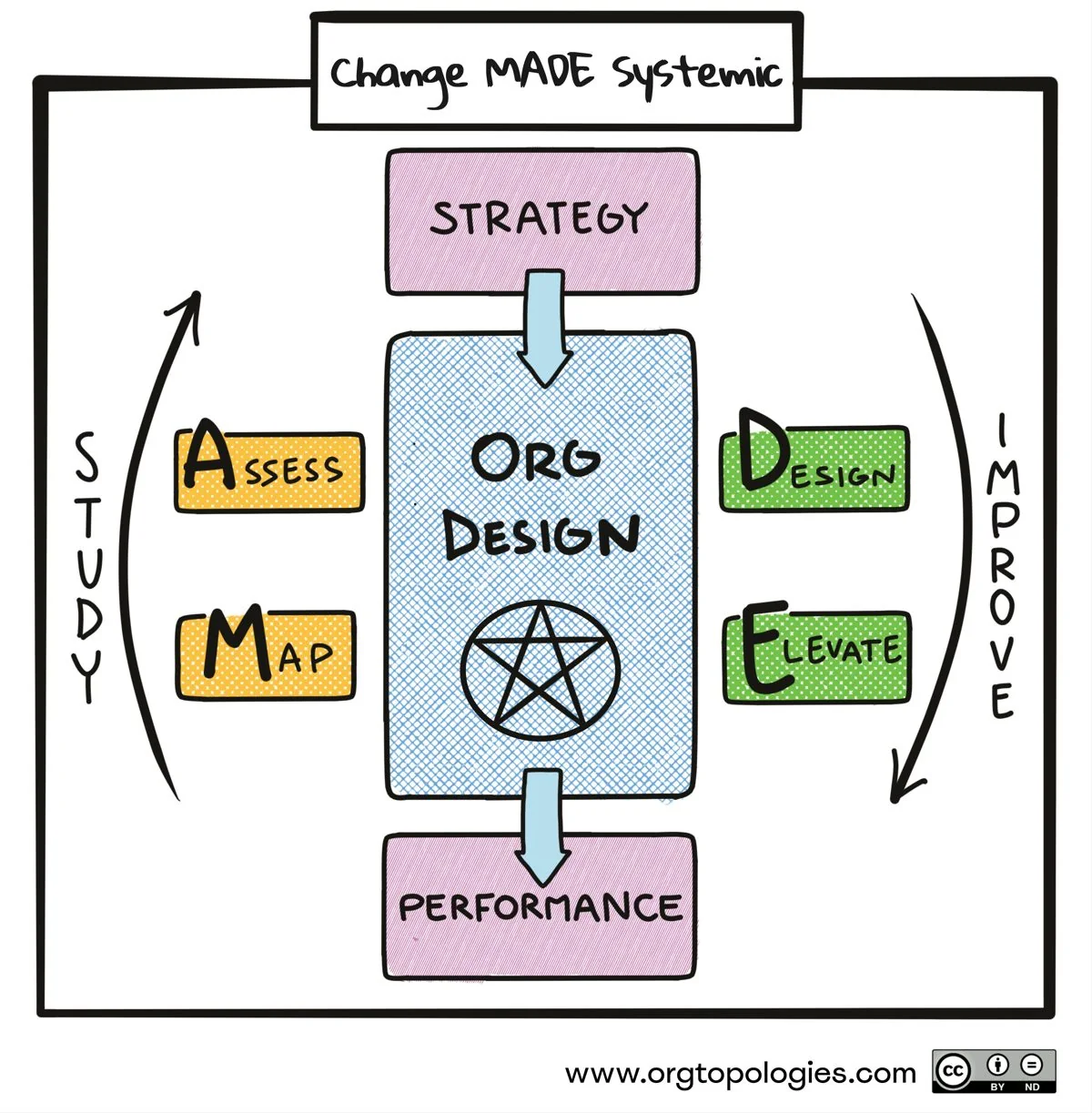 ILLUSTRATION · 10X ORG · CC BY-ND · DOWNLOAD ↓
Org design sits between strategy and performance. MADE is the loop that keeps it fit, named after its four moves: Map, Assess, Design, Elevate. First study the design you have, then improve toward the design you need.
Studythe design you have
- 01MapPlace every unit by skills and work mandate
- 02AssessName the topology you have — and whether it fits
Improvethe design you need
- 03DesignImagine the organization you need, without today’s limits
- 04ElevateGet the change going with Elevating Katas
ELEVATE · STEP 4 OF MADE
Elevating Katas
Elevating is a deliberate move right and up on the map. The katas are the moves: small, repeatable routines that change how the organization works. A menu, not a sequence: start with the few that match your most pressing constraint.
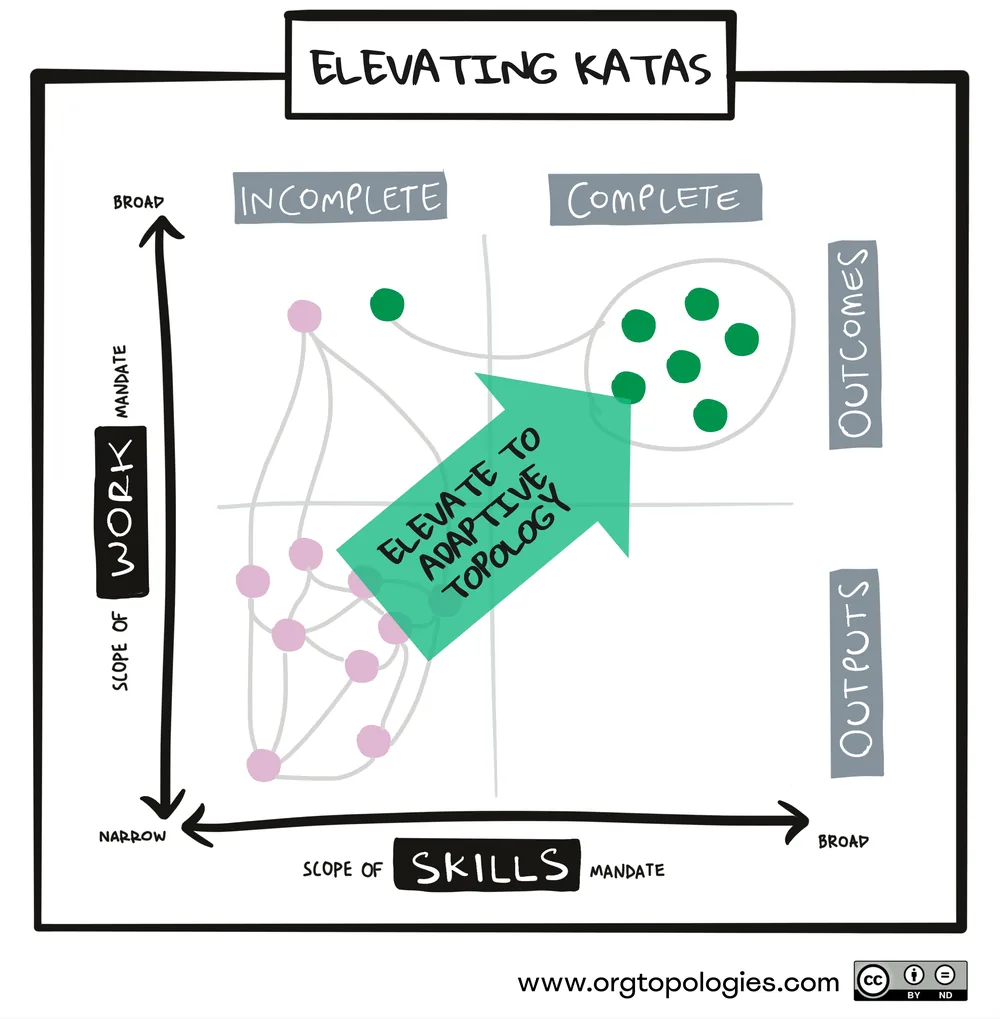
The katas are grouped by the five elements of Jay Galbraith’s Star Model™: change one element and the others must follow.
- 1Strategy Direction and Goals6 katas
- 2Structure Power, Authority, Organization7 katas
- 3Processes Information and Decision Flows9 katas
- 4Rewards Incentives and Motivation3 katas
- 5People Skills, Mindsets, Capabilities2 katas
Case studies rich in katas
All case studies with katas →LeSS Transformation in Wartime Ukraine: Building an Adaptive Organization at DIM.RIA
DIM.RIA's 50-person product organization replaced component teams and many manager backlogs with one Product Backlog and three cross-functional feature teams, cutting cycle time by about 80%.
Katas applied proposed
Elevating an EV Scale-up with Org Topologies
A scale-up flipped its 50-person R&D from component teams to three product areas in two days, then hit local-optimization pain and moved toward a single backlog.
Katas applied proposed


ACADEMY
Learn the Org Topologies approach
LIVE ONLINE · FOR LEADERS AND CHANGE AGENTS
C-OTP · Practitioner
Designing Adaptive Organizations for the Agentic Age. Live sessions for executives, managers, consultants and change agents who want to redesign their organization for performance — and then let AI accelerate it.
C-OTP dates →2-DAY BOOTCAMP · IN PERSON
C-OTC · Consultant
Org Redesign for the Agentic Age. Bring a real case, map it with Org Topologies, and leave with a practical redesign direction and first steps to test it. Includes the path to C-OTC accreditation.
Explore C-OTC →
All upcoming events
14–15 Oct 2026C-OTCAmsterdamIn personBootcamp – Org Redesign for Agentic Age from €1,655 excl. VATRegister →: Bootcamp – Org Redesign for Agentic Age, Amsterdam
- Where
- Leonardo Royal Hotel AmsterdamPaul van Vlissingenstraat 24, 1096 BK Amsterdam, NetherlandsGoogle Maps ↗OpenStreetMap ↗
- When
- Wed 14 Oct, 09:00 – Thu 15 Oct, 17:00 CESTAdd to Google Calendar ↗iCal / Outlook ↓
Tickets
- Early Bird: save 200until 31 DecSale ended
- Single TicketThis is a single ticket to the 2-day C-OTC training. This ticket does not provide access to the OT Summit.1 left€1,655
- Duo TicketThis is a duo ticket to the 2-day C-OTC training. This ticket does not provide access to the OT Summit.1 left€2,590
- Triple TicketThis is a triple ticket to the 2-day C-OTC training. This ticket does not provide access to the OT Summit.1 left€3,890
Prices exclude 21% VAT, added at checkout where it applies.
16 Oct 2026SummitAmsterdamIn personOrg Design Summit 2026€750 excl. VATRegister →: Org Design Summit 2026, Amsterdam
- Where
- Leonardo Royal Hotel | AmsterdamPaul van Vlissingenstraat 24, 1096 BK Amsterdam, NetherlandsGoogle Maps ↗OpenStreetMap ↗
- When
- Fri 16 Oct, 09:00–18:00 CESTAdd to Google Calendar ↗iCal / Outlook ↓
Tickets
- Early-Bird SaleSale ended
- Regular PriceSale ended
- Last Minute€750
Prices exclude 21% VAT, added at checkout where it applies.
22 Oct 2026OTX-ASTOnlineLiveApplied Systems Thinking €395 excl. VATRegister →: Applied Systems Thinking, Live online
- Where
- Online: the link comes with your ticket
- When
- Thu 22 Oct, 09:00–17:00 CESTAdd to Google Calendar ↗iCal / Outlook ↓
Tickets
- General Admission€395
Prices exclude 21% VAT, added at checkout where it applies.
10–24 Nov 2026C-OTPOnlineLiveDesigning Adaptive Organizations for the Agentic Agefrom €450 excl. VATRegister →: Designing Adaptive Organizations for the Agentic Age, Live online
- Where
- Online (Zoom): the link comes with your ticket
- When
- Tue 10 Nov, 11:00 – Tue 24 Nov, 15:00 CETAdd to Google Calendar ↗iCal / Outlook ↓
Tickets
- Early Birduntil 24 Oct5 left€450
- Standard Ticket€550
Prices exclude 21% VAT, added at checkout where it applies.
7–8 Dec 2026C-OTCHamburgIn personBootcamp – Org Redesign for Agentic Agefrom €1,495 excl. VATRegister →: Bootcamp – Org Redesign for Agentic Age, Hamburg
- Where
- Jensen & Komplizen GbRBahrenfelder Str. 52-54, 22765 Hamburg, GermanyGoogle Maps ↗OpenStreetMap ↗
- When
- Mon 7 Dec, 09:30 – Tue 8 Dec, 17:30 CETAdd to Google Calendar ↗iCal / Outlook ↓
Tickets
- Crazy Early Birduntil 3 OctSale ended
- Early Birduntil 14 Nov€1,495
- Regular: Single Ticket€1,695
- Group: Duo TicketThis is a two-person ticket to the training.€2,595
- Group: Triple TicketThis is a three-person ticket to the training.€3,895
Prices exclude 21% VAT, added at checkout where it applies.
17–18 Dec 2026C-OTCPragueIn personBootcamp – Org Redesign for Agentic Agefrom €990 excl. VATRegister →: Bootcamp – Org Redesign for Agentic Age, Prague
- Where
- Praga Office & GardenPernerova 702/39, Karlín, 186 00 Praha-Praha 8, CzechiaGoogle Maps ↗OpenStreetMap ↗
- When
- Thu 17 Dec, 09:00 – Fri 18 Dec, 17:00 CETAdd to Google Calendar ↗iCal / Outlook ↓
Tickets
- Crazy Early Birduntil 13 Oct5 left€990
- Early Birduntil 18 Dec5 left€1,090
- Regular: Single Ticket€1,290
- Group: Duo TicketThis is a two-person ticket to the training.€1,790
- Group: Triple TicketThis is a three-person ticket to the training.€2,490
Prices exclude 21% VAT, added at checkout where it applies.
11–12 Mar 2027C-OTCBrusselsIn personBootcamp – Org Redesign for Agentic Agefrom €1,295 excl. VATRegister →: Bootcamp – Org Redesign for Agentic Age, Brussels
- Where
- Horizon-1 BVBrussels, BelgiumGoogle Maps ↗OpenStreetMap ↗
- When
- Thu 11 Mar, 09:00 – Fri 12 Mar, 17:00 CETAdd to Google Calendar ↗iCal / Outlook ↓
Tickets
- Crazy Early Birduntil 30 Nov5 left€1,295
- Early Birduntil 31 Dec€1,495
- Regular: Single Ticket€1,695
- Group: Duo TicketThis is a two-person ticket to the training.€2,595
- Group: Triple TicketThis is a three-person ticket to the training.€3,895
Prices exclude 21% VAT, added at checkout where it applies.
Community
TALK TO THE AUTHORS LIVE
Learn with community
Practitioners share maps, and the authors join the conversation live in Slack.
Join Slack