

VUCA-Energy

A story about a company called VUCA-Energy that is trying to survive in the
VUCA-World.
Introduction
Imagine regionally regulated, fast-paced markets in an environment to be conquered.
driven by bleeding-edge technologies and lots of financial potential. One of those fields
is the energy market. While the economy has to keep running, the climate catastrophe
has to be stopped. Hence, a shift towards renewable energy is unavoidable. The ability
To support the green shift and obtain profits from it is key to success. This is the field
where VUCA-Energy (VUCA-E), a ~250-employee company, is trying to leave a mark and
to be a leader in energy trading, stationary battery storage, and vehicle-to-grid (V2G)
integration (VGI). Striving and surviving are highly dependent on the ability to seamlessly
Change direction while having a crystal-clear vision reinforced by a guiding strategy. The
The following image is a high-level view.

Now that we know the surroundings of VUCA-E, let’s have a look at the initial situation
roughly ~3 years ago, with a focus on the VGI area.
To do so, we want to apply the Org Topologies language and map the Product & Tech
business areas of VUCA-E. We want to see how VUCA-E has evolved over the last years. For
each relevant state, we map and analyze the business before we finally elevate towards
a fully adaptive organization—a reasonable match for the VUCA world.
Initial Situation
The company is not a fresh start-up. The company's organizational structure has undergone several changes.
We start our reflection and analysis of VUCA-E's environment from the phase when its
Relevance and competencies have been proven to their investors. By that time, multiple functional departments staffed with domain experts grew and siloed away from one
another:
The VGI area started as a small research team that built a prototype to prove if the idea
of combining VGI with energy trading is technically feasible. That was the case, and the
euphoria from investors' support imposed fast decision-making and ignorance of modern
concepts in org design, setting focus on the enhancement of expertise. The “classical
Scaling, in terms of specialist teams, was applied (based on bad mental models). This
way, multiple component-based tech teams have been set up. In addition, outsourced
web and app development is shielded away from the rest of the organization to cover
missing competencies within VUCA-E (2023). The Product Management and Technology
Areas within VGI appeared to coexist as separate departments.
Was it working well? The headcount rose and reached 350 employees. A common vision
and mission have been defined, but they were too vague and did not provide a unifying effect to the employees. Teams were not practicing alignment with each other because they did not feel a need. An organization based on a narrow consideration of business parts and
“Natural growth” emerged, which represents the classical directing archetype; see Image 2.

Image 2: Mess of the initial setup: too many roles, dependencies and bottlenecks, burning investor’s money
Spinning VUCA world
The VUCA world did what it does best—it took some unexpected turns, and in essence
The market did not grow as expected. Since the company was very much divided on
the structural and goals level, it struggled to generate valuable outcomes and the financial
Numbers dropped while the headcount reached its peak. That was when the investors
decided to hold back yet another round of investment until the numbers improved.
We could call this “the Big Bang,” which should have been a wakeup call, only that we are
not there yet. The management did what managers do in crisis: they hired an external
consultancy and raised the need for clear responsibilities of each component and task,
and defined single wringable necks. External consultants promoted the management’s
ideas and introduced a matrix organization with a clear hierarchy. In the tech area, they
created multiple siloed sales channels with strictly attached tech teams. The business
Development and product managers continued to function as a separate body, mostly passing tasks to the tech area. Ah, and as the numbers needed to get better, one-third of the employees had to be let go.
Intermediate Situation
VUCA-E ended up in an intermediate state where those external consultants created an
organizational design supposedly optimized to convince investors, yet insufficient to
handle the challenges ahead. You could call it fit for investors, yet not fit for purpose.
In a nutshell, VUCA-E evolved into the following setup (mapped on Image 3):
Business development separated away from product, separated away from tech. Each department with its own management team
~7 sales channels driven by people with individual interests (Project Managers—
PMs)
3 “agile” Scrum teams in tech strictly assigned to 3 sales channels
Exclusive team of architects to elaborate and drive a target architecture
The infrastructure team to establish an infrastructure layer
The security team is making sure the company complies with security standards
Domain/component owners responsible for the functionality and cleanliness of
their components, who were members of the Scrum teams. The component
Owners mainly defined the type of tasks a dev team would pick up (CAPS-3).
The Scrum Masters warned the management that this organizational design is not
sustainable in a VUCA world and predicted what would happen, but they have been ignored.
(Self-) Education in the field of org design seemed to be unnecessary for the management
because all problems come from bad workers and a tough business environment, where
VUCA-E has chosen to operate.

Image 3: Teams are aligned with sales channels, so the scope of work is limited to capabilities, yet the first signs of cross-functionality and end-to-end skills emerged! Dotted lines illustrate reporting lines, while solid lines illustrate working collaboration.
Challenges and problems in the intermediate situation
... created by the “solution” the external consultants came up with. The five elements of
The Galbraith star model was not aligned in this org design. Besides that, the following
issues arose:
Lack of unified goals
Misaligned goals for each sales stream (sales KPI)
Deadline-driven project work
No companywide strategy
Siloization & knowledge drain
Separation of Tech & BD & Product
Experienced colleagues leaving or being let go
Lack of adaptiveness and difficulty shifting priorities
Bad mood & poor motivation
Colleagues were laid off
Management decisions were questioned
Uncertainty within the organization
Management & investors & people-pleasing
Team Leads
Top-down decisions
Old-fashioned management style
Bottlenecks—generated through the following specialist teams:
Architects
Infrastructure team
Security team
Owners
With the specialist teams, a lot of dependencies with massive alignment needs have been
created. To make it worse, the tasks and responsibilities of these teams were described
as fuzzy. As a result, for some topics, it was unclear who was responsible, and the ping-pong
between teams began. Single wringable necks could not solve the problem, because
Setting individual responsibility per topic does not enable the creation of complete solutions.
It only causes communication overhead, delays, and a potential conflict of interest.
Management and external consultants could not take a holistic and analytical approach
to really solve the problems VUCA-E was facing. The result of the re-Org was ... yet
Another reorganization after 3 months because the VUCA world did what it does best—it took some unexpected turns. How did it impact the organization? The sales-streams with
strictly assigned development teams could not serve VUCA-E's needs any longer
because priorities shifted to other sales-streams that did not have any development
resources at that point in time (still CAPS-3).
Current Situation
Bearing in mind that VUCA-E had a reorganization only 3 months ago, it would most likely
be deadly to the employees’ morale if everything had to be fully reshaped again. Hence,
the strict assignment of Developers to sales streams was lifted so that they can deliver
end-to-end for whatever sales channel needs it the most: this org design is mapped on
Image 4. The ability to deliver end-to-end for any sales channel included a steep learning
curve, but with the right mindset, openness, and courage, this was possible in most
situations.
Yet the current situation is still insufficient when it comes to switching costs. Each Team
has its own product person assigned to it with its own interests. A vision, mission, and
clear goal setting could help to move in the same direction, but as each sales stream has
its own goals, each stream tries to work on its goals first, instead of driving the overall
company's mission. Consequently, the different sales channels must “fight for
resources to get into implementation. Teams that have worked once with a sales channel are very likely to continue working there. In addition, specialist roles such as, e.g., architects
further cemented the drift towards a delivery topology where teams act as feature
factories implementing predefined and specified tasks. This leads to the following:
problems:
Limited learning—"masked" ownership of sales channels, once there, always
there
Local optimizations—teams deliver, yet what they deliver is not always globally
relevant value
Specialization—specialist roles have a high reward; generalists are not promoted
Siloization—a sales channel becomes a silo
Issues with ownership—no product ownership and fear of expanding ownership on
tech side (collective ownership is not lived).
High switching costs—a result of the sum of the above—and a new priority kicked in
again and needs immediate support, imposing a reduction of scope and delayed
delivery of other commitments. Given the fact that VUCA-E was forced to switch
direction more than once and under tremendous switching costs, it is safe to say
that an adaptive topology should be the target topology. The past has proven the
In VUCA-E’s business, a delivery topology is not fit for purpose.

Image 4: Organization around several business parts—elevating towards a delivery topology
Future Vision
VUCA-E must be ready to conquer the vehicle-grid-integration sector of the energy
market as soon as the growth kicks in and the land-grabbing starts. Other companies
have massive advantages when it comes to financial resources and manpower. A potential
Technological advantage can be gone in the blink of an eye. Building a technological
foundation organized in a delivery topology creates a false impression of doing the right thing.
thing, because “hey, we deliver,” but as soon as the run starts, it will be too late to switch
the organizational topology because the costs will be too high and the speed too slow.
Hence, the VUCA_E’s future vision is optimized for adaptiveness with low switching
costs, minimal transaction costs, and a clear vision that gives direction across all
departments. Time to …
… MADElevate towards the Future Vision
Have a single empowered Product Owner (PO) who is accountable for the whole product,
a vehicle-grid-integration platform. The PO will get all the support needed from the subject.
matter experts (SME) and product managers (PM). Not only will they support the PO PO, but
they will also align business development and partnerships while driving the vision of the
VGI platform. The software engineers organize as teams that cover partial businesses or
more (PART-3/PART-4). They do not only develop software, but they help form the
product and have close contact with real customer problems that they solve. Goodbye
to the times when they got handed over wannabe user stories every two weeks. Expert
roles are no longer a bottleneck by design because they simply get integrated into the
teams where they will be a huge benefit with little onboarding time. By that hand-offs are
reduced, and a shared understanding of the platform is created. To develop the best
product, the teams and SMEs and PO must work together closely; PO, see Image 4.
In the long run the company could even elevate further and break the borders of the
departments introduced in Image 1. This would mean that all departments, namely
Trading, VGI, and Stationary have a shared vision and VUCA-E is organized with a holistic
product view, where software engineers are real product developers working on the
whole business (WHOLE-3/WHOLE-4).
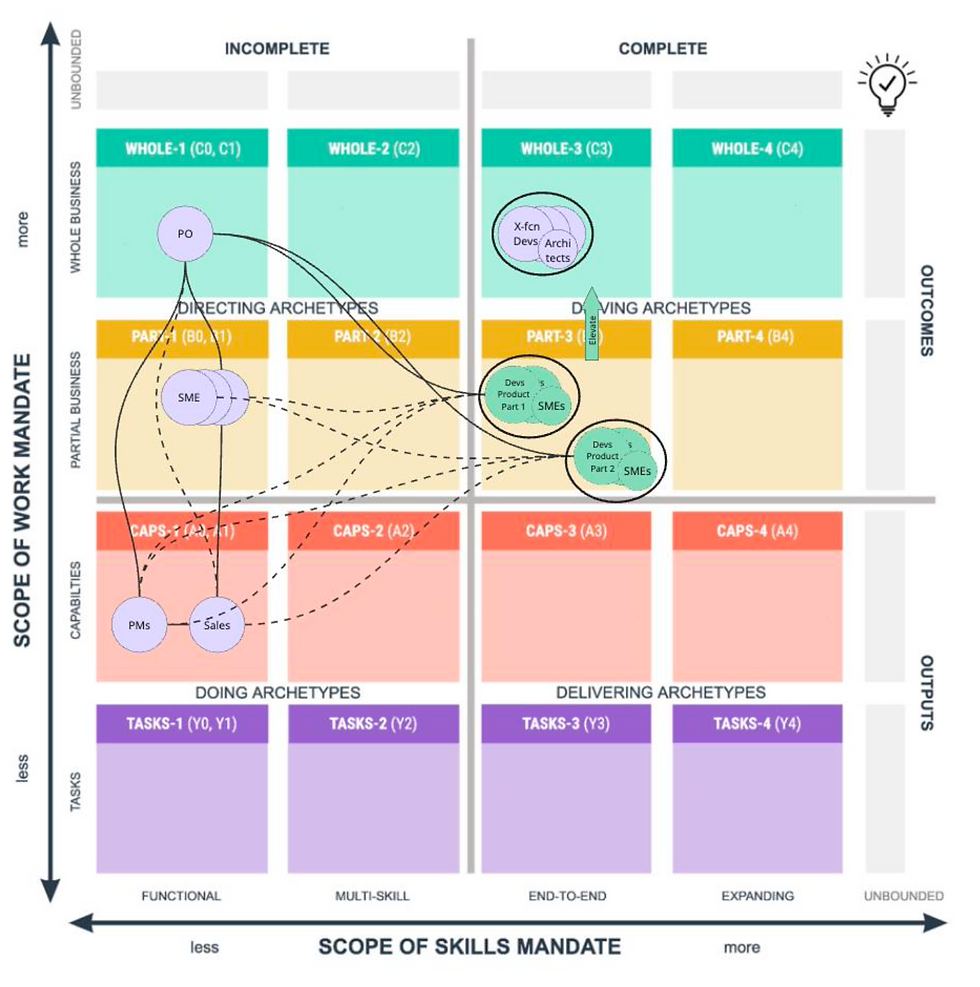
Image 5: PO as a senior role with decision power, cross-functional teams with integrated experts like architects, traders, data scientists
A case study by Irina Muhkha, Joschka Rinke, and Manfred Slaucher