
The MADE
method.
Map · Assess · Design · Elevate: see how your organization really works, then redesign it for the goal you choose — in four moves you can repeat.
ACADEMY
Learn the Org Topologies approach
Practitioner (C-OTP) and Consultant (C-OTC) classes, live online and in person.
Change, MADE systemic
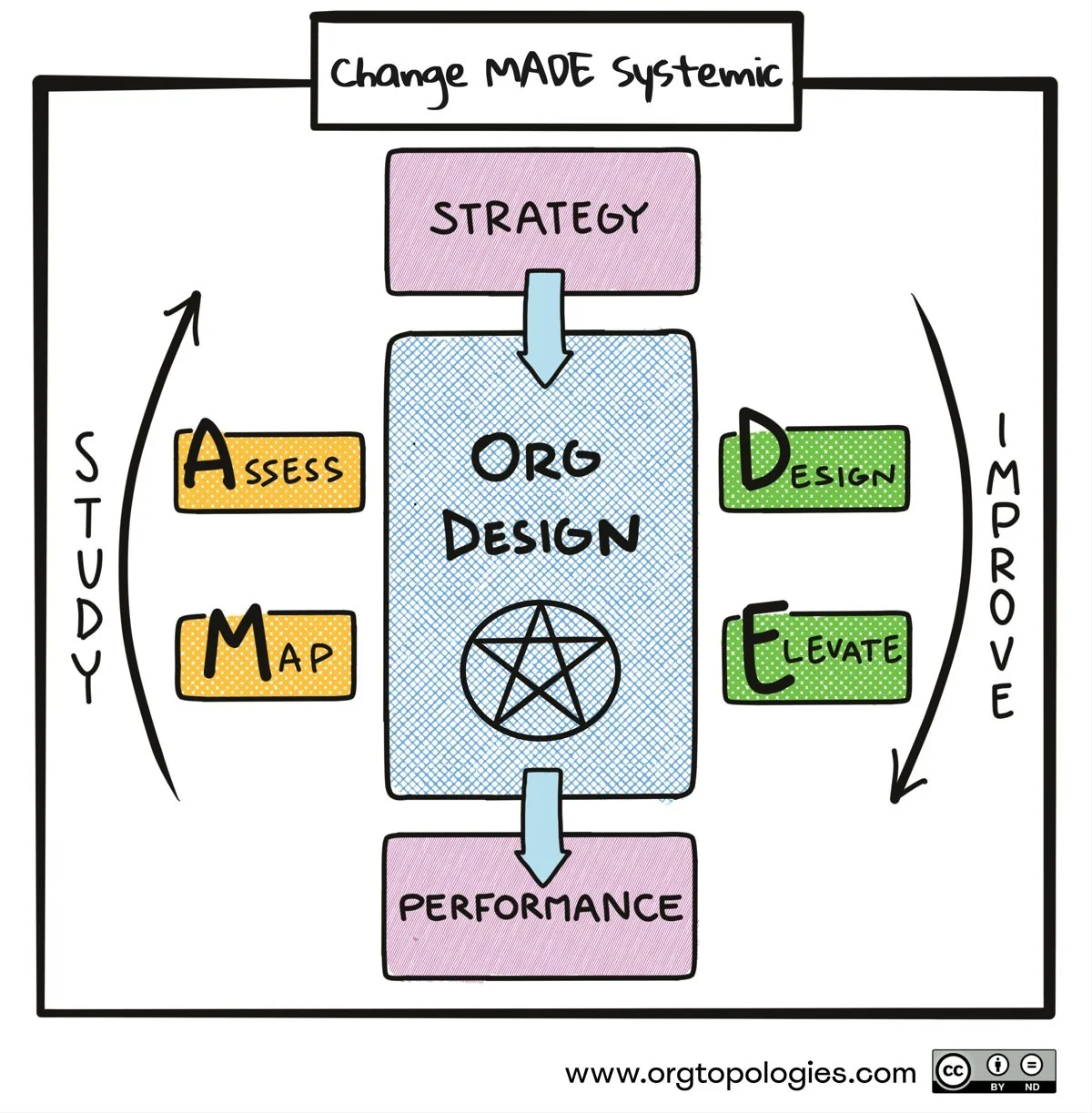
Org design sits between strategy and performance. MADE is the loop that keeps it fit, named after its four moves: Map, Assess, Design, Elevate. First study the design you have, then improve toward the design you need.
Studythe design you have
Improvethe design you need
- 03DesignImagine the organization you need, without today’s limits
- 04ElevateGet the change going with Elevating Katas
01STUDY · THE DESIGN YOU HAVE
Map
Place every unit by its two mandates: how broad its skills are (→) and how much of the work it owns (↑).
STEP GOAL · FROM 10X ORG
Which parts of our organization contribute to creating value, and how do they interact to produce it — from idea to cash?
CORE VALUE · CURIOSITY
People, teams and AI agents all go on the same map. Lines show who depends on whom. Here: a product manager and a project manager direct two complete teams of people and AI agents.
This is not reproducing the org chart with titles and layers. You study the kinds of work units take on, the inputs they rely on, the outputs they produce, and how work actually flows between them.
Go to the Gemba
Map where work actually happens — not how the slides say it happens.
Without judgment
See the system as it really works today, before deciding how to improve it.
With curiosity
Without curiosity, mapping quickly degenerates into justification.
Why it matters: in a study of nearly 200 org design consultants, more than half said their clients find it hard to trace how people collaborate across units.
“Mapping does not change the organization. But without mapping, change is blind.”
02STUDY · THE DESIGN YOU HAVE
Assess
Compare your map with the three topologies. What is this organization designed for — and does that fit your strategy?
STEP GOAL · FROM 10X ORG
Given the current org design and its emerging capabilities, how well does it fit the business ambitions and organizational strategy?
CORE VALUE · HONESTY
Directing units decide what to build; complete teams deliver it within narrow, fixed scopes. That pattern is a Delivery Topology.
Resource
Built for utilization of specialized skills.
Fits stable, repeatable work. Slow to change direction.
DeliveryTHIS MAP
Built for fast, predictable flow of outputs.
Fits known demand. Teams ship within narrowly defined areas for faster flow.
Adaptive
Built for innovation and adaptability, to create more value.
Fits product R&D where user habits and market demands keep changing.
03IMPROVE · THE DESIGN YOU NEED
Design
Imagine the organization you need — without today’s limits. Choose the org goal, then sketch the target design.
STEP GOAL · FROM 10X ORG
What should this organization be optimizing for, and which strategic capabilities does it need to develop to better serve its future?
CORE VALUE · COMMITMENT
Don’t start from who sits where today. No topology is best; fit for purpose is, and different parts of one company can choose different designs. In this example the goal is adaptiveness: everyone works as one team of teams in the Driving quadrant.
| ORG GOAL | WHEN | DESIGN TOWARD |
|---|---|---|
| Utilization | stable, repeatable demand | Resource |
| Flow | known demand, fast delivery | Delivery |
| Adaptiveness | uncertain, changing markets | AdaptiveTHIS EXAMPLE |
| Both, by part | a steady core plus a new venture | A mix |
04IMPROVE · THE DESIGN YOU NEED
Elevate
Now get the change going. Elevating Katas™ are small, safe experiments that widen skills and work mandates toward the target design.
STEP GOAL · FROM 10X ORG
How do we make this new org design work in practice to build the missing capabilities?
CORE VALUE · OPENNESS
The dashed circles show the target design; the arrows show the direction of change. Run the katas, then remap and start the loop again.
ONE PATH FOR THIS EXAMPLE · 4 KATAS
STRUCTURE
Form a team of teams
The two teams join one product group.
STRATEGY
Merge product backlogs
One backlog for the whole product: the work mandate grows ↑
STRATEGY
Re-center product ownership on outcomes
Managers stop directing outputs; teams own the outcome.
PROCESSES
Hold product-level reviews
Everyone inspects the whole product together, every cycle.
ACADEMY
Learn the Org Topologies approach
All upcoming events
 10–24 Nov 2026OnlineOnline Class – Leading the Agentic Shift: Rewire the R&D Organization
 €550 excl. VATLearn moreThese practical live sessions are for executives, managers, consultants and change agents who want to redesign their organization for performance — and then let AI accelerate it.
 7–8 Dec 2026HamburgBootcamp – Org Redesign for Agentic Agefrom €1,495 excl. VATLearn moreA two-day, in-person bootcamp for consultants and leaders who redesign organizations. Bring a real case, map it with Org Topologies, and leave with a practical redesign direction and first steps to test it, so AI's speed turns into business results. Includes the path to C-OTC accreditation.
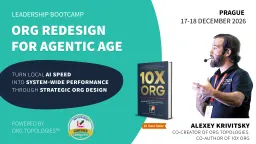 17–18 Dec 2026PragueBootcamp – Org Redesign for Agentic Agefrom €1,290 excl. VATLearn moreA two-day, in-person bootcamp for consultants and leaders who redesign organizations. Bring a real case, map it with Org Topologies, and leave with a practical redesign direction and first steps to test it, so AI's speed turns into business results. Includes the path to C-OTC accreditation.
Community
TALK TO THE AUTHORS LIVE
Learn with community
Practitioners share maps, and the authors join the conversation live in Slack.
Join Slack