
TL;DR
- Platform teams are starting to build AI factories, agent setups and pipelines in isolation, and customer-facing teams are expected to rent them.
- This repeats premature platformization from the pre-AI years: over-engineering, waiting and silos.
- The people who add value should own the factory they use; shared tools and skills can still grow out of that work.
Two Lands
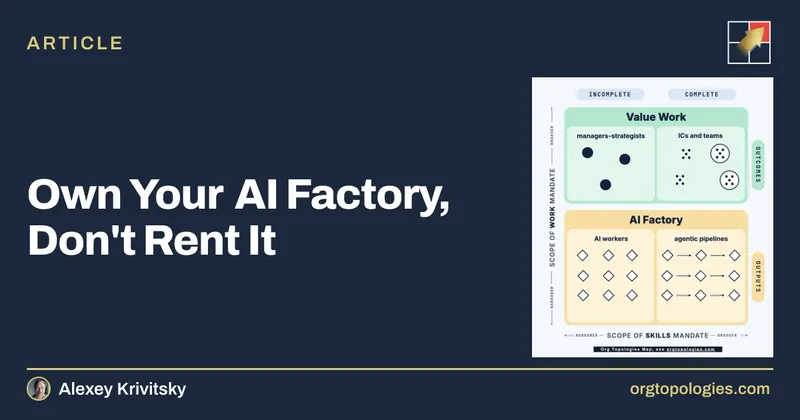
I see the product-engineering organizations splitting into two lands. Down in the output land, AI workers and agentic pipelines are taking over more and more of the doing and delivering. Up in the outcome land, managers, ICs and teams work out what is worth building and point the AI factory at where the value is.
So it is tempting to call the AI factory a platform that value is built on. But we know what happens in the organizations when something is called a "platform". Very quickly, someone creates platform teams and fences them from the rest of the org.
The Platform Trap, Again
That takes me straight back to the expensive failures of large-scale agile adoptions in the pre-AI years. Then, many organizations split their people into platform teams and customer-facing teams. Sounds reasonable, good on paper. But this leads to unexpected, undesirable org dynamics.
Helping many organizations with this issue, I witnessed firsthand how platform teams, cut off from customers and outcomes, tended to over-engineer things the value teams never asked for, while feature teams waited on a platform they had no mandate to change. Some years ago, I called this antipattern "premature platformization". Something to avoid.
Now I see the same pattern coming back with AI. Platform teams build AI factories, agent setups, and pipelines in isolation, and customer-facing teams (the top-right quadrant of the map) are expected to RENT them.
Own the Factory
My view is that the people who add value should OWN the factory they use. An agent setup that serves one outcome is rarely right for another, and you cannot tune it well without knowing that outcome's requirements and constraints in depth.
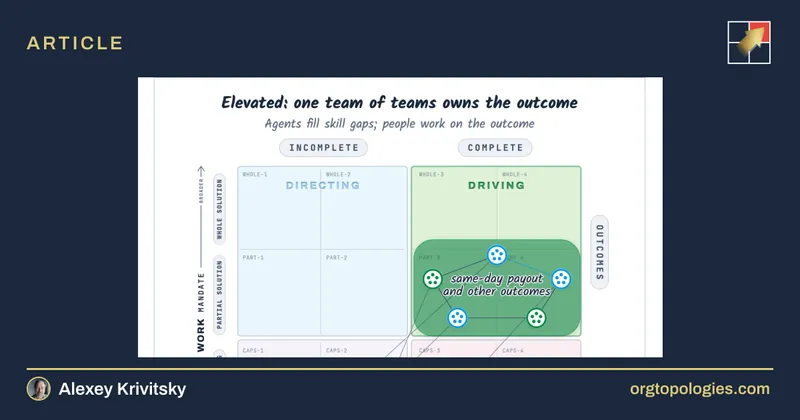
My view: agentic setups must be tailor-made for the outcomes. So the ICs and teams in the complete-outcome quadrant of the map should evolve, experiment with, and innovate on their own agent infrastructure for better outcomes.
Shared tools and human skills can still grow out of that work, but they emerge from real use rather than being designed upfront, far away from the customers.
Let's not rebuild the silos of the last decade.
From the Discussion
The post started a good discussion on LinkedIn. Here are my answers from the comments.
It is too early to standardize. I truly believe it is way too early to standardize and outsource agentic setups to platform teams.
Evals need real work. Eval systems, which we don't focus on well enough, should run against REAL work that only the value teams know of. I also see with my clients that different kinds of customer work lead to different tunings of the agentic setup. This cannot be done by the platform teams: it is not a question of expertise, they are missing the context.
Owning versus renting. To go one level deeper on that, imagine a dedicated platform team develops a solution. Along the way, they would learn quite a lot about what it took them to build it and how to maintain it. The other teams didn't get any of this learning.
So when the value teams run into problems with these automations, they have to trust the "expertise" of the platform teams. And the platform teams, of course, would explain that it is all very hard to explain, and the asynchronous dependencies, handoffs and waiting times are here again. What could have been a transformative journey might end up again entrenched in departments with different goals.
Simpler tools. I witnessed many cases, long before AI, where the people who owned only the infrastructure made it 100x more complex than it needed to be. They also locked the companies into the tools they wanted to put on their CVs.
Collective, not private, ownership. I am against sole private ownership. Collective ownership of shared infrastructure is a great idea. Some teams can focus on building and improving it, while the others keep the choice to use it or not, learn it, and adapt it to their actual needs.

ACADEMY
Learn the Org Topologies approach
All upcoming events
 10–24 Nov 2026OnlineOnline Class – Leading the Agentic Shift: Rewire the R&D Organization
 €550 excl. VATLearn moreThese practical live sessions are for executives, managers, consultants and change agents who want to redesign their organization for performance — and then let AI accelerate it.
 17–18 Dec 2026PragueBootcamp – Org Redesign for Agentic Agefrom €1,290 excl. VATLearn moreA two-day, in-person bootcamp for consultants and leaders who redesign organizations. Bring a real case, map it with Org Topologies, and leave with a practical redesign direction and first steps to test it, so AI's speed turns into business results. Includes the path to C-OTC accreditation.
 12–26 Jan 2027OnlineOnline Class – Leading the Agentic Shift: Rewire the R&D Organization€550 excl. VATLearn moreThese practical live sessions are for executives, managers, consultants and change agents who want to redesign their organization for performance — and then let AI accelerate it.
Community
TALK TO THE AUTHORS LIVE
Learn with community
Practitioners share maps, and the authors join the conversation live in Slack.
Join Slack