
SaaS
LeSS: a team of teams on one product backlog

Framework mapping / LeSS
FRAMEWORK MAPPING
Large-Scale Scrum (LeSS) by Bas Vodde and Craig Larman is one of the cornerstone bodies of knowledge for designing, creating, and sustaining adaptive ecosystems.
From the book 10X ORG: Large-Scale Scrum (LeSS) by Bas Vodde and Craig Larman, Nexus by Ken Schwaber and others, Fluid Adaptive Scaling Technology (FASTagile) originated by Quinton (Ron) Quartel, and Creating Agile Organizations (CAO) by Cesario Ramos are cornerstone bodies of knowledge for designing, creating, and sustaining adaptive ecosystems.
All adaptive approaches share a common organizing principle: they aim to remove fences around silos, individuals and teams, and optimize for the fluid exchange of ideas, skills, and collaboration. In short, defining broader mandates to create a bigger brain. Building and sustaining an Adaptive Topology can look costly; adaptability requires investment, and learning is the currency. But the payoff is flexibility, resilience, and ongoing relevance in a world that won’t stop changing.
Scrum does not really define the vertical ideal to aim for, which may help explain why Scrum implementations often become a team-level game: pockets of “Scrums” scattered across an organization, each working “effectively and efficiently” on its own part. The book’s answer: LeSS helps here. Its concept of Product Definition points directly to the breadth of the work mandate, how broadly teams understand the Product.
The broader the Product Definition within the organization, the more elements, such as components, modules, IT systems, processes and funnel stages, are seen not as separate small “products,” but as dependent parts of a larger Product that must be managed holistically. That choice shapes org design and the management system: will you have many output-level “owners,” or one outcome-level Owner?
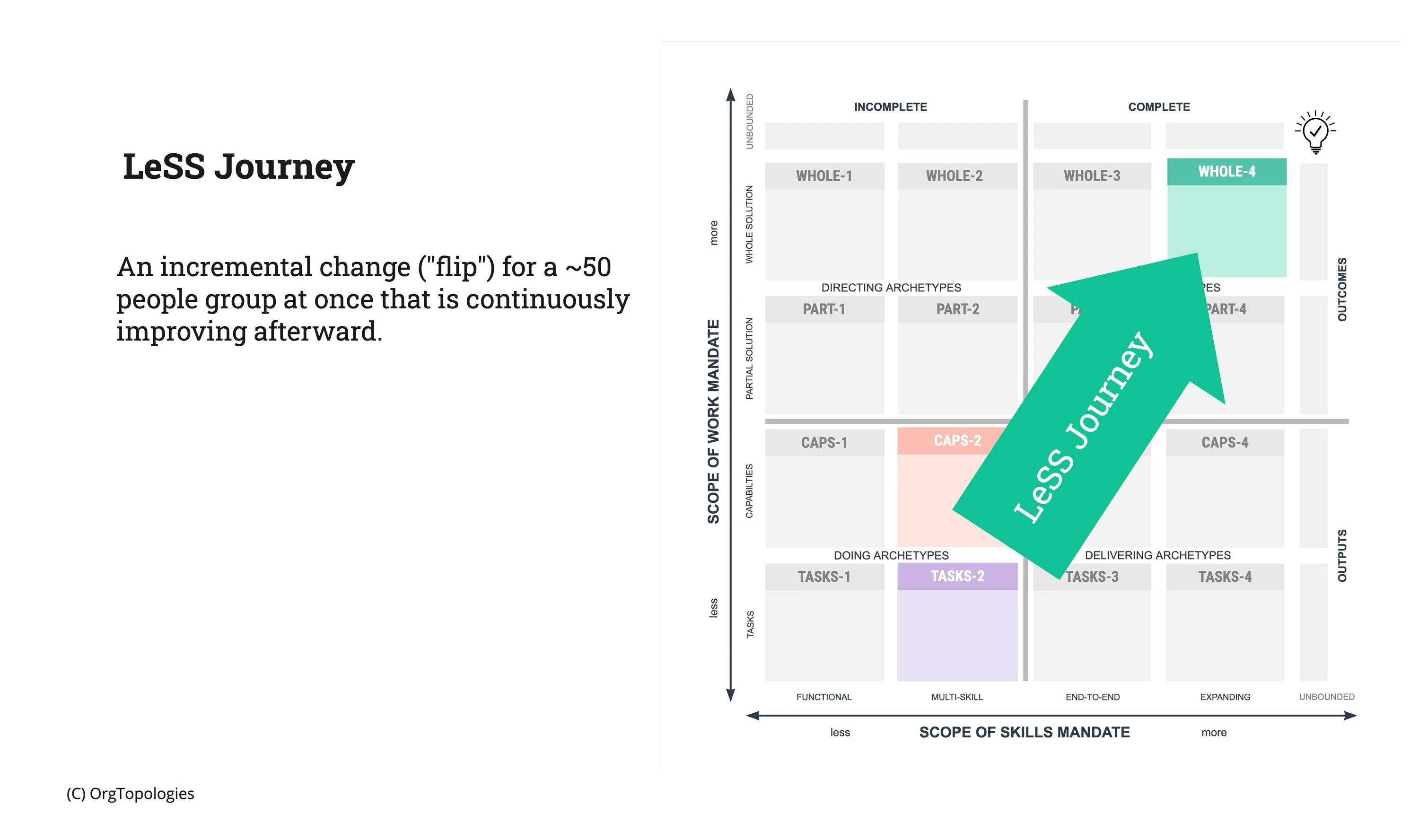
A feature team, in LeSS, is a cross-functional, cross-component, long-living, customer-facing, self-managing team. The book explains why both halves matter: teams aiming for high adaptiveness aren’t merely cross-functional. Combining multiple skills moves a team only along the horizontal axis of the map. Adaptive Topology requires units that are both cross-functional and cross-component, and move across both axes.
The book tells the case of Y Soft, a Czech-based B2B printing solutions company with a LeSS adoption. Twenty versatile product teams operate together as a genuine team of teams, tackling shared business and product challenges, with strategic direction set by just two product managers. The roadmap serves as the single, strategic Product Backlog, and teams pull high-value, outcome-oriented work from it.
Because there is no predefined specialization, broad learning occurs, strongly connected to business outcomes. One of the product managers told the authors that when the company acquired a tech company for its unique software, the existing teams mastered the new codebase and incorporated it into the larger offering within just two weeks.
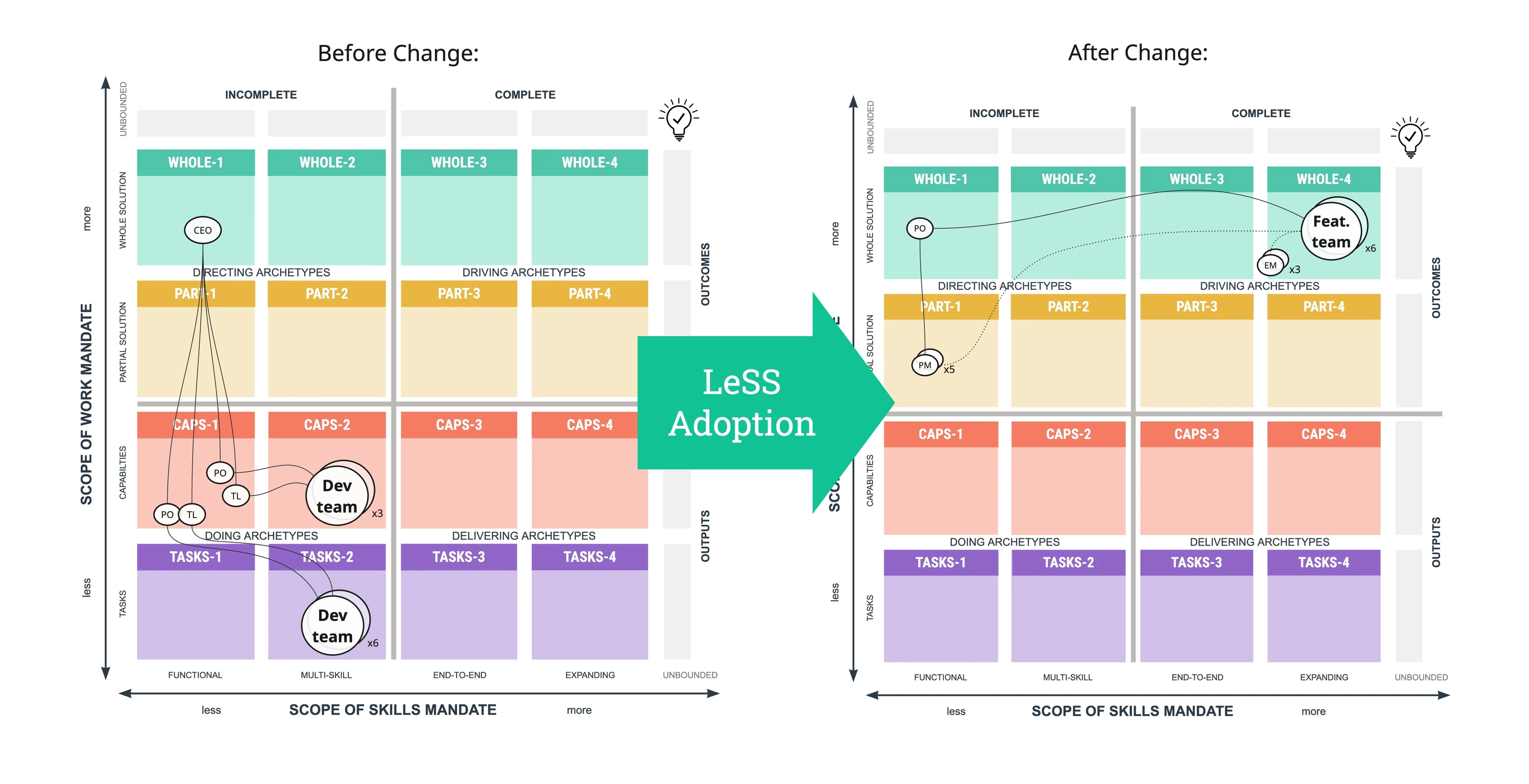
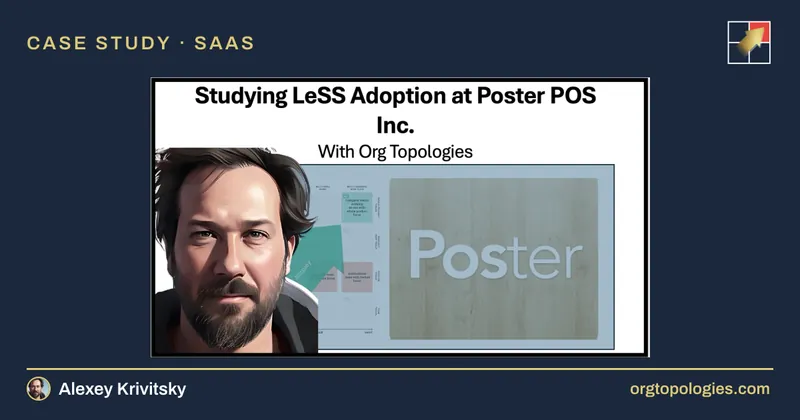
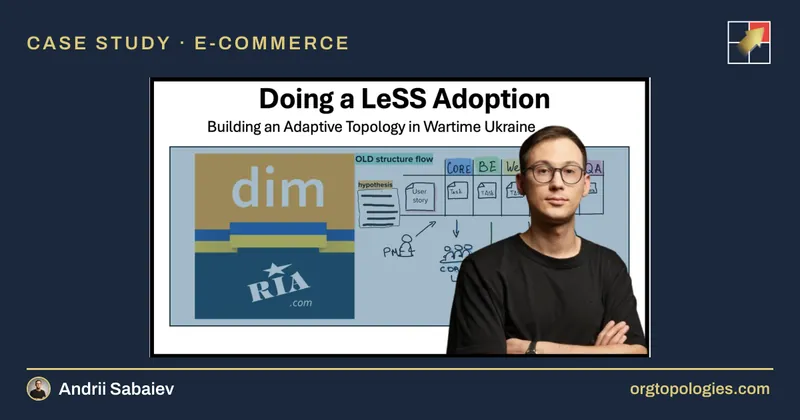
In 2021, Poster, a Ukraine-based SaaS company, reshaped itself, inspired by LeSS ideas such as global optimization with a whole-product focus and delivery of high-value work by customer-facing feature teams. Our case study maps the journey: from a dozen narrow teams built around a technology, a component or a feature set, to six feature teams working across the whole product, sharing one Product Backlog with one Product Owner.
The Definition of Done grew to include customer onboarding: a feature was done once one selected client was actively using it and satisfied. Poster went through the Covid-19 lockdowns and served its B2B customers during the war in Ukraine, and even grew its clientele, a real sign of resilience. Business resilience comes from high organizational adaptability, and high adaptability comes from an org design that enables it.
Read the Poster case study, see all LeSS mappings, or map your own organization in the C-OTC class. The whole argument is in the book 10X ORG at 10xorg.com.
LeSS (Large-Scale Scrum) is by Craig Larman and Bas Vodde and offered by The LeSS Company B.V. This page is our independent analysis; it is not endorsed by The LeSS Company.
MAPPINGS
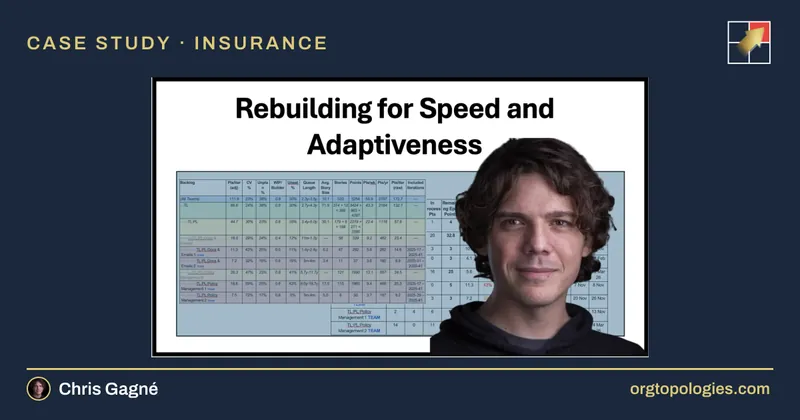
Case studies and articles that map it with Org Topologies.



FAQ
ACADEMY
Learn the Org Topologies approach
Practitioner (C-OTP) and Consultant (C-OTC) classes, live online and in person.