
METHOD · APPENDIX A OF 10X ORG
Elevating
Katas.
Structured, repeatable improvement routines that turn organizational design intent into lived behavior.
ACADEMY
Learn the Org Topologies approach
Practitioner (C-OTP) and Consultant (C-OTC) classes, live online and in person.
KATAS AS A TERM
A practiced sequence, not a one-off transformation
The term kata comes from martial arts, where it describes a practiced sequence used to build skill and judgment through repetition. In management it was popularized through Toyota: a studied, repeatable pattern for disciplined improvement.
The 10X Org principles set direction. The katas make that direction actionable. They are applied in the Elevate step of the MADE method, where insights from mapping, assessment and design turn into concrete change.
Each kata targets a concrete constraint, such as team boundaries, decision rights, interfaces, policies or governance, and tests whether expanding mandates or reducing friction moves the system closer to the intended elevated state.
Elevating Katas are problem-driven, not methodology-driven.
THE ELEVATION JOURNEY
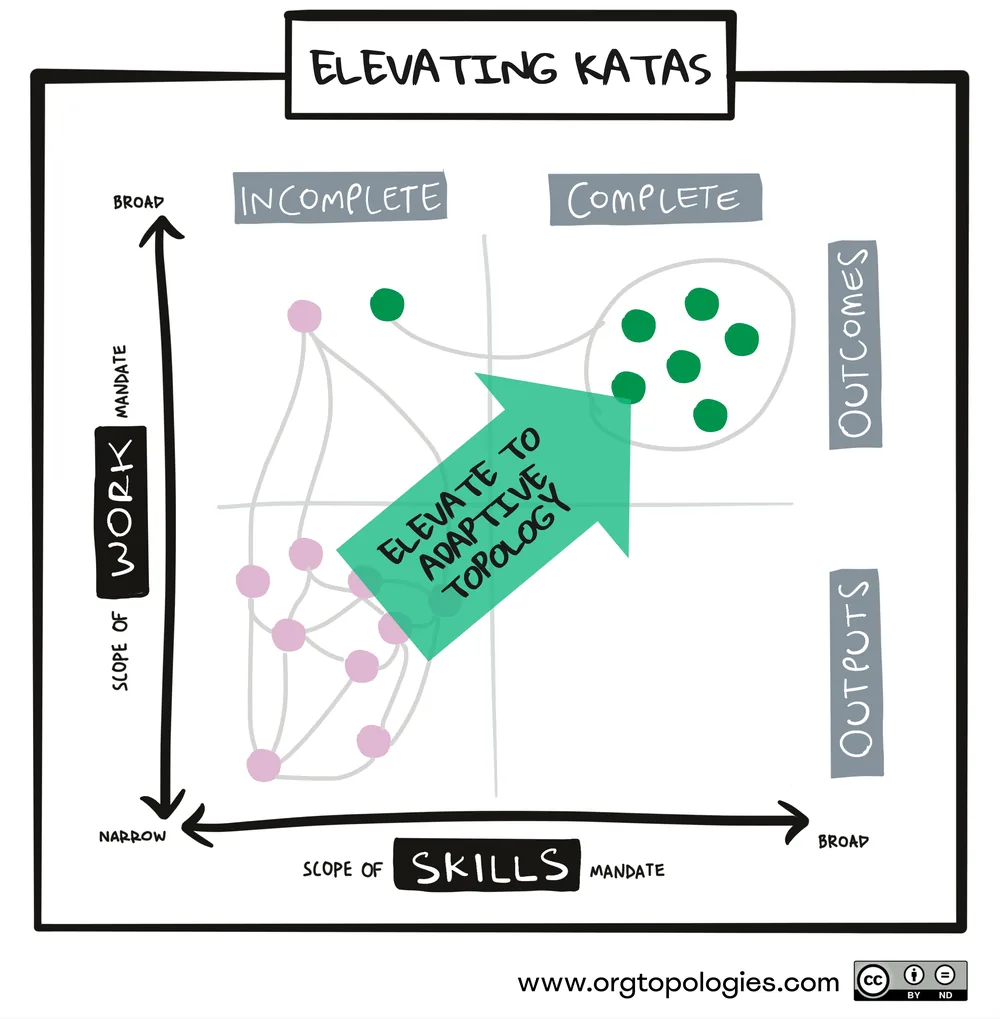
Elevate toward the top right of the map
Elevating is a deliberate move right and up on the Org Topologies map: broader skills and broader work mandates, from delivering outputs to delivering outcomes.
A menu, not a sequence
The katas are not meant to be applied top-to-bottom. They form a menu of deliberate moves. The right starting point depends on where an organization’s constraints sit on the map.
Start small, then expand
Organizations typically begin with a few katas that match their most pressing design challenges, then expand or shift their use as learning accumulates.
Not only for software
In service organizations, “product” maps to a service offering, customer journey, case type or operational capability. Backlogs become service queues; reviews become service inspections.
KEEPING KATAS SYSTEMIC
Five ways katas move the whole system
Leaders don't need another transformation program. Choose a handful of katas and make sure they are practiced faithfully: as the routines become habits, agility and resilience grow, and the culture follows the work.
- Whole system
- A kata never tweaks one element in isolation: it touches governance, roles, events, practices and artifacts together, as the Star Model asks.
- Strategy
- Routines such as multi-team Product Backlog Refinement or vertical slicing bring the strategic goal into the daily work, so structure and process follow strategy.
- People and roles
- Katas like Elevate Product Ownership stretch roles beyond their old definitions; repeated practice grows the skills the new design needs.
- Behavior and culture
- Culture programs fail on abstract values. Katas change the working pattern itself, and the desired behavior (collaboration, customer focus, learning) comes with it.
- Rewards
- Because a kata repeats, it closes its own feedback loop: faster cycle times, better product fit and more engaged teams reward the new habit.
Katas on the Star Model · Appendix A of 10X ORG
Katalog
Katalog groups the katas by the five elements of org design in Jay Galbraith’s Star Model™. Change one element and the others must follow. Every kata links to its description and to the case studies that apply it.
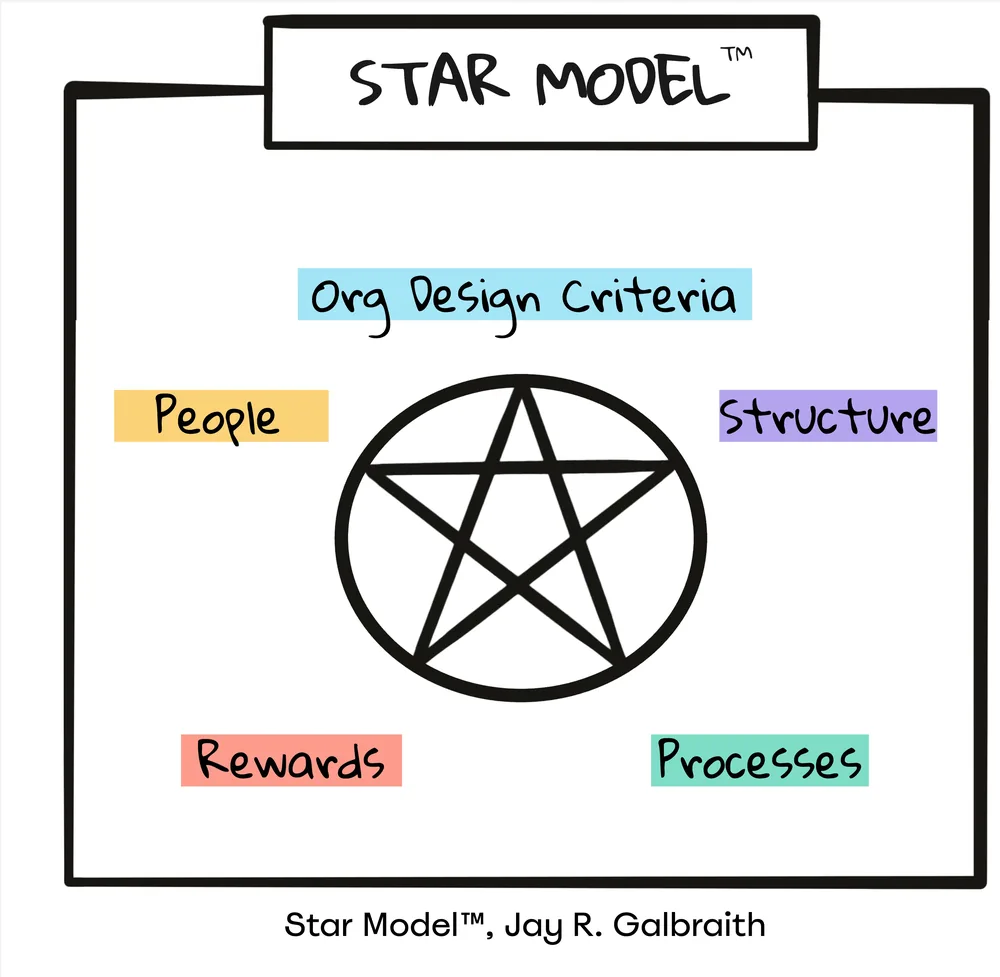
Jay Galbraith’s Star Model™ teaches that an organization is not just its org chart or the sum of its policies, but a system of interconnected design choices that must be made deliberately and kept in sync.
Five elements make up the star: the org design criteria derived from strategy, structure, processes, rewards and people. When they are aligned and reinforce one another, performance becomes more reliable and less accidental.
Change only one and the others pull back. A company that adopts Scrum as a process add-on, while hiring, rewards and structure stay as they were, gets the predictable result: “Agile is dead.” The katas work on all five elements, so change becomes systemic.
“People behave according to how they are measured, organized, and rewarded.”
1 StrategyDirection and Goals
Org Design Criteria: The outcomes the organization is designed to achieve are derived from the strategy and are used as the benchmark for all design choices.
1.1 Expanding the Product Definition8 cases
Deliberately broaden what the organization considers "the product" so teams orient around real customer outcomes rather than narrow components or tasks.
AppliedMultipleCase Studies: Org Topologies in Action
Poster aimed for whole-product orientation instead of component focus.
← Back to Case Studies: Org Topologies in ActionAppliedFintechCase Study: Introduction of Org Topologies™ in European Fintech
Teams moved from owning components to a whole-product view.
Note by Alexey Krivitsky, 2024-12: Adopting a Whole-Product Perspective: Repeatedly mapping and reevaluating team scopes from isolated components toward broader product domains. Over time, this sustained focus on holistic ownership helps teams better understand end-to-end customer needs, reducing fragmentation and dependency.
← Back to Case Study: Introduction of Org Topologies™ in European FintechAppliedSaaSCase Study: Studying LeSS Adoption at Poster POS Inc. with Org Topologies
Single-team value areas were dropped; all teams work on the whole product.
← Back to Case Study: Studying LeSS Adoption at Poster POS Inc. with Org TopologiesProposedR&DRedesigning an organization with Cynefin Estuarine mapping and Org Topologies
Planned for months 4-6 of the 2026 roadmap.
← Back to Redesigning an organization with Cynefin Estuarine mapping and Org TopologiesProposedEnergyVUCA-Energy
Long-term vision widens the product to all departments with a shared vision.
← Back to VUCA-EnergyProposedEnergyFrom Renting Resources to Driving Strategy: A Shift Toward Business-Oriented R&D
Broader product thinking is part of the desired state, not yet confirmed as done.
← Back to From Renting Resources to Driving Strategy: A Shift Toward Business-Oriented R&DProposedHigh-tech manufacturingIdentifying Shared Skills to Elevate a Complex Product Org with Org Topologies
Named in the text as part of the elevation.
← Back to Identifying Shared Skills to Elevate a Complex Product Org with Org TopologiesProposedAviationCase Study: Introducing Org Topologies in an Aviation Program
Planned customer-journey roadmap; fit to kata is loose.
Note by Alexey Krivitsky, 2024-12: Roadmap Based on Customer Journeys: Routinely aligning development efforts with end-to-end customer experiences. By iteratively refining a customer-centric roadmap, teams continuously close gaps between business goals and technical execution.
← Back to Case Study: Introducing Org Topologies in an Aviation Program
1.2 Re-Centering Product Ownership on Strategy and Outcomes18 cases
Position product ownership where strategic intent and value meet, with responsibility for outcomes rather than team-level delivery coordination. This requires avoiding team-level local product ownership and introducing shared or unified product ownership structures.
AppliedHealth techFrom domain silos to strategic ownership: How FloHealth evolved its operating model with the GM structure
GM owns vision, strategy and commercial outcomes per big bet, not delivery coordination.
← Back to From domain silos to strategic ownership: How FloHealth evolved its operating model with the GM structureAppliedHigh-tech manufacturingDesigning for Paradigm: Bringing Business and IT Together at Europe’s Largest Tech Firm
Planned shift of the PO from tasking to goal-setting.
← Back to Designing for Paradigm: Bringing Business and IT Together at Europe’s Largest Tech FirmAppliedR&DRedesigning an organization with Cynefin Estuarine mapping and Org Topologies
Product ownership elevated and POs trained; feature owner role also recommended.
← Back to Redesigning an organization with Cynefin Estuarine mapping and Org TopologiesAppliedE-commerceLeSS Transformation in Wartime Ukraine: Building an Adaptive Organization at DIM.RIA
One PO decides priorities; product managers became subject-matter experts without own backlogs.
← Back to LeSS Transformation in Wartime Ukraine: Building an Adaptive Organization at DIM.RIAAppliedInsuranceRebuilding for Speed and Adaptiveness
Product ownership moved to value-stream and overall level; team output owners avoided.
← Back to Rebuilding for Speed and AdaptivenessAppliedEnergyFrom Renting Resources to Driving Strategy: A Shift Toward Business-Oriented R&D
Move to one product owner for the product, creating friction in prioritization and mandate.
← Back to From Renting Resources to Driving Strategy: A Shift Toward Business-Oriented R&DAppliedSaaSHow Much Adaptivity Is Enough? PandaDoc's Journey with Large-Scale Scrum (LeSS)
Product owner moved from backlog management to steering investment across areas.
← Back to How Much Adaptivity Is Enough? PandaDoc's Journey with Large-Scale Scrum (LeSS)AppliedEnergyElevating an EV Scale-up with Org Topologies
One Product Owner per area replaced team-level product managers.
← Back to Elevating an EV Scale-up with Org TopologiesAppliedIndustrial R&DCase Study: Using Org Topologies to Assess the Evolutionary Journey Within Eurecat-FPED, an R&D Organization from Catalonia (Spain)
Heads of R&D lines moved to prioritization and stakeholder management.
Note by Alexey Krivitsky, 2024-12: Head of R&D Lines Transitioning Toward Product Ownership: Rather than top-down control, Heads of R&D lines repeatedly practiced delegating responsibilities and focusing on stakeholder management and strategic prioritization. This shift, repeated and refined over multiple cycles, helped the organization progressively align leadership roles with Agile principles, reinforcing a more responsive and value-oriented governance structure.
← Back to Case Study: Using Org Topologies to Assess the Evolutionary Journey Within Eurecat-FPED, an R&D Organization from Catalonia (Spain)AppliedDigital services[Français] Org Topologies & Stratégie Kanban pour augmenter son agilité business
Un seul PO porte la connaissance client de l'unité.
← Back to [Français] Org Topologies & Stratégie Kanban pour augmenter son agilité businessAppliedHR techCase Study: Enhancing Strobbo's Agile Journey with Org Topologies
PO shifted from day-to-day coordination to stakeholders and outcomes.
Note by Alexey Krivitsky, 2024-12: Unifying Product Ownership: Moving from individual team-based product owners to a more unified product ownership structure. This elevates product strategy and ensures that the product vision is collectively understood, prioritized, and managed. Instead of each team interpreting the product direction in isolation, a unified product ownership model helps maintain strategic coherence and alignment across the entire product landscape.
← Back to Case Study: Enhancing Strobbo's Agile Journey with Org TopologiesAppliedFintechCase Study: Introduction of Org Topologies™ in European Fintech
Recognized holistic product ownership; evidence is awareness, not a clear structural change.
← Back to Case Study: Introduction of Org Topologies™ in European FintechAppliedSaaSCase Study: Studying LeSS Adoption at Poster POS Inc. with Org Topologies
One Product Owner orders the whole-product backlog instead of team-level POs.
← Back to Case Study: Studying LeSS Adoption at Poster POS Inc. with Org TopologiesProposedAutomotiveStudying Elevation Opportunities in Automotive Data Exchange
Product Manager and Product Owner shift to outcome framing and shared prioritization.
← Back to Studying Elevation Opportunities in Automotive Data ExchangeProposedEnergyVUCA-Energy
Future vision replaces per-team product persons with one accountable PO.
← Back to VUCA-EnergyProposedHigh-tech manufacturingIdentifying Shared Skills to Elevate a Complex Product Org with Org Topologies
Fewer POs aligned to strategic markets; product managers lose priority authority.
← Back to Identifying Shared Skills to Elevate a Complex Product Org with Org TopologiesProposedAviationCase Study: Introducing Org Topologies in an Aviation Program
Planned step 3: CPO anchors product direction; business and tech programs joined.
← Back to Case Study: Introducing Org Topologies in an Aviation ProgramProposedBankingCase Study: Using Org Topologies™ to Analyze the Agile Transformation Journey at a Large Dutch Bank
Proposed single HR backlog owned by the director; HR managers chose separate backlogs instead.
← Back to Case Study: Using Org Topologies™ to Analyze the Agile Transformation Journey at a Large Dutch Bank
1.3 Adopting Strategic, Outcome-Based Backlog3 cases
Shift backlog items from output commitments to explicit outcome hypotheses, making learning and impact visible in everyday prioritization. In service organizations: adopting service queues framed around client outcomes, not request types.
AppliedHigh-tech manufacturingDesigning for Paradigm: Bringing Business and IT Together at Europe’s Largest Tech Firm
Planned move from team-level feature lists to measurable outcomes.
← Back to Designing for Paradigm: Bringing Business and IT Together at Europe’s Largest Tech FirmAppliedHR techCase Study: Enhancing Strobbo's Agile Journey with Org Topologies
Backlog reframed around adoption and impact.
← Back to Case Study: Enhancing Strobbo's Agile Journey with Org TopologiesAppliedBankingCase Study: Business Banking Transformation Journey at de Volksbank
Backlogs moved from operational requests to customer-journey features.
← Back to Case Study: Business Banking Transformation Journey at de Volksbank
1.4 Merging Product Backlogs12 cases
Reduce fragmentation by consolidating competing backlogs into fewer shared ones, forcing real prioritization at the level where value is created.
AppliedR&DRedesigning an organization with Cynefin Estuarine mapping and Org Topologies
Three directions' backlogs consolidated into shared backlogs.
← Back to Redesigning an organization with Cynefin Estuarine mapping and Org TopologiesAppliedE-commerceLeSS Transformation in Wartime Ukraine: Building an Adaptive Organization at DIM.RIA
All managers' separate backlogs merged into one Product Backlog.
← Back to LeSS Transformation in Wartime Ukraine: Building an Adaptive Organization at DIM.RIAAppliedInsuranceRebuilding for Speed and Adaptiveness
Hierarchy of backlogs with reporting across levels; most work still on team backlogs, merge planned.
← Back to Rebuilding for Speed and AdaptivenessAppliedEnergyElevating an EV Scale-up with Org Topologies
One backlog per product area replaced per-component backlogs.
← Back to Elevating an EV Scale-up with Org TopologiesAppliedHR techCase Study: Enhancing Strobbo's Agile Journey with Org Topologies
Note by Alexey Krivitsky, 2024-12: Merging Product Backlogs: Instead of multiple, disconnected backlogs, the organization merges them into a single, shared backlog. This structure forces transparency, reduces competing priorities, and keeps all teams focused on the same highest-value opportunities. Similar to the “Merge Product Backlogs” kata, this elevates the entire organization’s workflow by ensuring that work items are consistently prioritized at a product (rather than team) level.
← Back to Case Study: Enhancing Strobbo's Agile Journey with Org TopologiesAppliedSaaSCase Study: Studying LeSS Adoption at Poster POS Inc. with Org Topologies
Team-level backlogs were replaced by one common product backlog for all feature teams.
← Back to Case Study: Studying LeSS Adoption at Poster POS Inc. with Org TopologiesAppliedBankingCase Study: Using Org Topologies™ to Analyze the Agile Transformation Journey at a Large Dutch Bank
Task-level team backlogs replaced by one product owner and one backlog across several teams.
← Back to Case Study: Using Org Topologies™ to Analyze the Agile Transformation Journey at a Large Dutch BankProposedHealth techFrom domain silos to strategic ownership: How FloHealth evolved its operating model with the GM structure
Single ranked priority list per big bet named as the structural fix.
← Back to From domain silos to strategic ownership: How FloHealth evolved its operating model with the GM structureProposedHigh-tech manufacturingDesigning for Paradigm: Bringing Business and IT Together at Europe’s Largest Tech Firm
Listed as a potential future kata.
← Back to Designing for Paradigm: Bringing Business and IT Together at Europe’s Largest Tech FirmProposedAutomotiveStudying Elevation Opportunities in Automotive Data Exchange
One unified backlog per value stream instead of separate Product, Design, Engineering and Infra backlogs.
← Back to Studying Elevation Opportunities in Automotive Data ExchangeProposedPublic sectorOrg Topologies Case-Study by Koen Siegers >> "It started over dinner ..."
Recommended next step; one backlog per team still existed.
← Back to Org Topologies Case-Study by Koen Siegers >> "It started over dinner ..."ProposedHigh-tech manufacturingIdentifying Shared Skills to Elevate a Complex Product Org with Org Topologies
Each team-of-teams works from one backlog.
← Back to Identifying Shared Skills to Elevate a Complex Product Org with Org Topologies
1.5 Organizing Around Products, Not Projects2 cases
Replace temporary project slices with long-lived ownership of products, preserving learning and accountability over time.
AppliedSaaSHow Much Adaptivity Is Enough? PandaDoc's Journey with Large-Scale Scrum (LeSS)
Long-lived stable teams as the core organizational unit.
← Back to How Much Adaptivity Is Enough? PandaDoc's Journey with Large-Scale Scrum (LeSS)AppliedMultipleStudying Org Designs of Haier's RDHY and Bayer's DSO
Units are formed around product lines, not projects.
← Back to Studying Org Designs of Haier's RDHY and Bayer's DSO
1.6 Minimizing Distance to Customers9 cases
Create regular, direct contact between teams and customers so decisions are informed by reality rather than assumptions or proxies.
AppliedMultipleStudying Org Designs of Haier's RDHY and Bayer's DSO
Micro-enterprises and Bayer's squads work directly with users instead of through layers.
← Back to Studying Org Designs of Haier's RDHY and Bayer's DSOAppliedDigital services[Français] Org Topologies & Stratégie Kanban pour augmenter son agilité business
Analytique produit, entretiens et tests utilisateurs intégrés au flux.
← Back to [Français] Org Topologies & Stratégie Kanban pour augmenter son agilité businessAppliedHR techCase Study: Enhancing Strobbo's Agile Journey with Org Topologies
Stated aim; pursued via outward-facing PO and goal metrics.
← Back to Case Study: Enhancing Strobbo's Agile Journey with Org TopologiesAppliedDigital servicesBusiness Agility with Org Topologies and Kanban
User tests, analytics and in-team UX practice.
← Back to Business Agility with Org Topologies and KanbanAppliedFintechCase Study: Introduction of Org Topologies™ in European Fintech
Forgotten-PW team talked directly to customers.
Note by Alexey Krivitsky, 2024-12: Increasing Direct Customer Interaction: Embedding routines where teams regularly engage with customers or user feedback. Over time, these habitual feedback loops guide more precise product choices, strengthen customer alignment, and improve the speed and relevance of delivered solutions.
← Back to Case Study: Introduction of Org Topologies™ in European FintechProposedAutomotiveStudying Elevation Opportunities in Automotive Data Exchange
Engineers and designers talk to customers directly for faster feedback.
← Back to Studying Elevation Opportunities in Automotive Data ExchangeProposedEnergyVUCA-Energy
Engineers to work directly on real customer problems rather than receive handed-over stories.
← Back to VUCA-EnergyProposedEnergyFrom Renting Resources to Driving Strategy: A Shift Toward Business-Oriented R&D
Teams working directly with customers is part of the target vision.
← Back to From Renting Resources to Driving Strategy: A Shift Toward Business-Oriented R&DProposedAviationCase Study: Introducing Org Topologies in an Aviation Program
Planned pilot with an end-user inside a team.
Note by Alexey Krivitsky, 2024-12: Pilot End-User Integration: Regularly involving actual users or domain experts directly within teams. Over time, this deepens customer empathy, guides product decisions, and ensures solutions better match real-world needs.
← Back to Case Study: Introducing Org Topologies in an Aviation Program
2 StructurePower, Authority, Organization
How power and authority are distributed: roles, units, reporting lines, and the basic architecture of who reports to whom.
2.1 Expanding Units Toward End-to-End Outcome Ownership23 cases
Broaden team mandates so they can complete work from intent to realized value. In practice, this often exposes the need to simplify the organization by eliminating separate units responsible for "preparing" or "finishing" work, resulting in a more coherent and adaptive org design.
AppliedE-commerceDescriptive Study of an e-retail Transformation Program Organization
Front-end and integration people moved into Content, Order and Payment teams, making them cross-functional.
← Back to Descriptive Study of an e-retail Transformation Program OrganizationAppliedHigh-tech manufacturingDesigning for Paradigm: Bringing Business and IT Together at Europe’s Largest Tech Firm
Target: PART-3 teams that include business staff and Ops.
← Back to Designing for Paradigm: Bringing Business and IT Together at Europe’s Largest Tech FirmAppliedEnergyVUCA-Energy
Developers freed from fixed sales channels to deliver end-to-end wherever needed.
← Back to VUCA-EnergyAppliedPublic sectorOrg Topologies Case-Study by Koen Siegers >> "It started over dinner ..."
Release and acceptance units folded into teams; implementation stayed separate for now.
← Back to Org Topologies Case-Study by Koen Siegers >> "It started over dinner ..."AppliedMultipleCase Studies: Org Topologies in Action
De Volksbank hubs combine business, IT and operations under one outcome responsibility.
← Back to Case Studies: Org Topologies in ActionAppliedEnergyElevating an EV Scale-up with Org Topologies
Component teams became end-to-end teams.
← Back to Elevating an EV Scale-up with Org TopologiesAppliedMultipleStudying Org Designs of Haier's RDHY and Bayer's DSO
Haier's micro-enterprises own a whole product line, from R&D to service, as their own profit-and-loss center.
← Back to Studying Org Designs of Haier's RDHY and Bayer's DSOAppliedIndustrial R&DCase Study: Using Org Topologies to Assess the Evolutionary Journey Within Eurecat-FPED, an R&D Organization from Catalonia (Spain)
R&D lines became complete end-to-end teams.
← Back to Case Study: Using Org Topologies to Assess the Evolutionary Journey Within Eurecat-FPED, an R&D Organization from Catalonia (Spain)AppliedDigital services[Français] Org Topologies & Stratégie Kanban pour augmenter son agilité business
Analystes, testeurs, développeurs et prestataire fusionnés en une équipe.
← Back to [Français] Org Topologies & Stratégie Kanban pour augmenter son agilité businessAppliedBankingExperience Report: Towards Business-Oriented Org Design at Raiffeisen Bank
Eleven speedboat teams took end-to-end ownership of features.
Note by Alexey Krivitsky, 2024-12: Introducing “SpeedBoat” End-to-End Teams: Instead of building teams around technical domains or components, the organization starts to form “SpeedBoat” teams capable of delivering customer-facing features end-to-end. This repeated approach of creating and refining multi-component, customer-focused teams works as a kata: each newly formed SpeedBoat team reinforces the pattern of aligning delivery structures with value streams, reduces dependencies, and cultivates adaptability.
← Back to Experience Report: Towards Business-Oriented Org Design at Raiffeisen BankAppliedDigital servicesBusiness Agility with Org Topologies and Kanban
BA, QA and developers merged; external dev force joined the team.
Note by Alexey Krivitsky, 2024-12: Forming Cross-Functional, Customer-Oriented Teams: Transitioning from separate specialist units (BAs, QA, Dev) to more integrated teams capable of handling end-to-end work. Repeatedly merging previously siloed roles encourages shared understanding, reduces handoffs, and aligns everyone around a common goal—improving flow and predictability.
← Back to Business Agility with Org Topologies and KanbanAppliedFintechCase Study: Introduction of Org Topologies™ in European Fintech
Forgotten-PW team's mandate broadened to a product part.
← Back to Case Study: Introduction of Org Topologies™ in European FintechAppliedR&DCase Study: from Component Teams to Team Topologies to FaST Agile
Component teams became stream-aligned teams shipping features end-to-end.
← Back to Case Study: from Component Teams to Team Topologies to FaST AgileAppliedBankingCase Study: Business Banking Transformation Journey at de Volksbank
Teams added developers and took over product duties from the brands.
← Back to Case Study: Business Banking Transformation Journey at de VolksbankAppliedBankingCase Study: Using Org Topologies™ to Analyze the Agile Transformation Journey at a Large Dutch Bank
IT component teams merged with business specialists into cross-functional teams.
← Back to Case Study: Using Org Topologies™ to Analyze the Agile Transformation Journey at a Large Dutch BankProposedR&DRedesigning an organization with Cynefin Estuarine mapping and Org Topologies
Listed as a long-term strategy.
← Back to Redesigning an organization with Cynefin Estuarine mapping and Org TopologiesProposedAutomotiveStudying Elevation Opportunities in Automotive Data Exchange
Move teams from CAPS to PART-3 with end-to-end ownership, starting with self-onboarding.
← Back to Studying Elevation Opportunities in Automotive Data ExchangeProposedE-commerceLeSS Transformation in Wartime Ukraine: Building an Adaptive Organization at DIM.RIA
Design and analytics, still outside teams, named as the next step.
← Back to LeSS Transformation in Wartime Ukraine: Building an Adaptive Organization at DIM.RIAProposed[Français] Initier l’alignement de son organisation et de sa stratégie avec Org Topologies™
Hypothetical merge of analysis, development and production into one team.
← Back to [Français] Initier l’alignement de son organisation et de sa stratégie avec Org Topologies™ProposedBanking[Français] Cartographie d'un groupe d'équipes avec OrgTopologies
Broader scope of responsibility and autonomy was the stated direction; Ops team to be split up.
← Back to [Français] Cartographie d'un groupe d'équipes avec OrgTopologiesProposedInitiate the alignment of your organization and strategy with Org Topologies™
Analysis and production skills merged into one team (illustrative case); time-to-market fell 20%.
← Back to Initiate the alignment of your organization and strategy with Org Topologies™ProposedAviationCase Study: Introducing Org Topologies in an Aviation Program
Planned step 2: fold separate spec, test, sim and architect units into teams.
Note by Alexey Krivitsky, 2024-12: Integrating Cross-Functional Expertise Into Teams: Incrementally merging roles (e.g., spec, test, architect) into development teams. Repeated application of this practice eliminates external dependencies, improves flow, and enhances adaptability to changing requirements.
← Back to Case Study: Introducing Org Topologies in an Aviation ProgramProposedBankingFacilitating a Mapping Workshop with Org Topologies™
Participants proposed grouping BA, programmers and Ops into multi-functional teams with broader responsibility.
← Back to Facilitating a Mapping Workshop with Org Topologies™
2.2 Forming a Team-of-Teams13 cases
Create a lightweight structure where teams align around shared goals while retaining autonomy in execution.
AppliedHealth techFrom domain silos to strategic ownership: How FloHealth evolved its operating model with the GM structure
Virtual core team aligns several domain teams around one initiative while they keep autonomy.
← Back to From domain silos to strategic ownership: How FloHealth evolved its operating model with the GM structureAppliedHigh-tech manufacturingDesigning for Paradigm: Bringing Business and IT Together at Europe’s Largest Tech Firm
Target: three partial-solution teams coordinating themselves.
← Back to Designing for Paradigm: Bringing Business and IT Together at Europe’s Largest Tech FirmAppliedInsuranceRebuilding for Speed and Adaptiveness
Teams grouped under two value streams, later shown as a team-of-teams.
← Back to Rebuilding for Speed and AdaptivenessAppliedEnergyDoing a LeSS Flip in Two Months with Org Topologies
Teams were grouped into three customer-segment areas.
← Back to Doing a LeSS Flip in Two Months with Org TopologiesAppliedSaaSHow Much Adaptivity Is Enough? PandaDoc's Journey with Large-Scale Scrum (LeSS)
Teams grouped into customer-focused requirement areas within one product.
← Back to How Much Adaptivity Is Enough? PandaDoc's Journey with Large-Scale Scrum (LeSS)AppliedEnergyElevating an EV Scale-up with Org Topologies
Each product area works as a team of cross-functional teams.
← Back to Elevating an EV Scale-up with Org TopologiesAppliedPublic sectorAnalyzing The Transformation Of A SAP Group At A Large Public Authority (Deloitte)
Teams were grouped into three release trains, a team-of-teams structure.
← Back to Analyzing The Transformation Of A SAP Group At A Large Public Authority (Deloitte)AppliedR&DCase Study: from Component Teams to Team Topologies to FaST Agile
Seven coupled teams merged into one collective.
← Back to Case Study: from Component Teams to Team Topologies to FaST AgileProposedAutomotiveStudying Elevation Opportunities in Automotive Data Exchange
Onboarding, Buying and Selling teams-of-teams with product, design and delivery roles.
← Back to Studying Elevation Opportunities in Automotive Data ExchangeProposedHigh-tech manufacturingIdentifying Shared Skills to Elevate a Complex Product Org with Org Topologies
Design target: two end-to-end teams-of-teams.
← Back to Identifying Shared Skills to Elevate a Complex Product Org with Org TopologiesProposedBanking[Français] Cartographie d'un groupe d'équipes avec OrgTopologies
Workshop sketched grouping three teams, three times, into multi-functional teams of teams.
← Back to [Français] Cartographie d'un groupe d'équipes avec OrgTopologiesProposedBankingExperience Report: Towards Business-Oriented Org Design at Raiffeisen Bank
Tribes group speedboat teams per business area, rolled out one by one.
Note by Alexey Krivitsky, 2024-12: Transitioning to Business-Oriented Tribes: Moving from domain-based units towards Tribes organized around clear business areas, each with end-to-end responsibility, represents another kata. As the organization repeatedly applies this structural shift, each Tribe formation and refinement cycle solidifies a focus on customer outcomes. Over time, this recurring pattern continuously elevates the organizational design toward greater clarity, accountability, and responsiveness to changing priorities.
← Back to Experience Report: Towards Business-Oriented Org Design at Raiffeisen BankProposedSaaSCase-Study: Loglass Using Org Topologies to Set Target Org Design
Target is B-level teams of teams, via FAST collectives.
← Back to Case-Study: Loglass Using Org Topologies to Set Target Org Design
2.3 Moving Toward Multi-Team, Cross-Functional Line Management1 case
Shift management focus from individual teams to multi-team value areas, enabling coordination and learning across boundaries.
AppliedBankingCase Study: Business Banking Transformation Journey at de Volksbank
Hubs with business, IT and operations replaced departmental management.
← Back to Case Study: Business Banking Transformation Journey at de Volksbank
2.4 Redefining the Manager Role Around Capability-Building and System Stewardship3 cases
Shift managers away from issuing instructions toward growing people and expanding mandates—developing the capabilities and judgment required for broader, end-to-end ownership while stewarding the system that surrounds the work.
AppliedMultipleStudying Org Designs of Haier's RDHY and Bayer's DSO
Middle management gives way to autonomous units supported by shared platforms.
← Back to Studying Org Designs of Haier's RDHY and Bayer's DSOAppliedIndustrial R&DCase Study: Using Org Topologies to Assess the Evolutionary Journey Within Eurecat-FPED, an R&D Organization from Catalonia (Spain)
The unit head shifted from controlling to delegating.
← Back to Case Study: Using Org Topologies to Assess the Evolutionary Journey Within Eurecat-FPED, an R&D Organization from Catalonia (Spain)ProposedBankingCase Study: Business Banking Transformation Journey at de Volksbank
Pilot learning calls for repurposing middle managers to serve teams.
← Back to Case Study: Business Banking Transformation Journey at de Volksbank
2.5 Enabling Team Self-Design4 cases
Enable teams to redesign their own composition and boundaries within clear strategic and mandate constraints, increasing ownership and fitness for purpose.
AppliedEnergyDoing a LeSS Flip in Two Months with Org Topologies
Teams designed themselves on flip day.
← Back to Doing a LeSS Flip in Two Months with Org TopologiesAppliedEnergyElevating an EV Scale-up with Org Topologies
Teams took part in forming the new teams at the flip.
← Back to Elevating an EV Scale-up with Org TopologiesAppliedR&DCase Study: from Component Teams to Team Topologies to FaST Agile
The FaST Collective reshapes its own teams regularly.
← Back to Case Study: from Component Teams to Team Topologies to FaST AgileProposedSaaSCase-Study: Loglass Using Org Topologies to Set Target Org Design
FAST's Value Cycle is the planned self-organizing mechanism.
← Back to Case-Study: Loglass Using Org Topologies to Set Target Org Design
2.6 Decentralizing Cross-Cutting Concerns Through Communities4 cases
Decentralize ownership of cross-cutting concerns (such as architectural guidelines, standards, and policies) by enabling self-organizing communities to evolve practices collaboratively, reducing dependency on centralized coordination.
AppliedE-commerceDescriptive Study of an e-retail Transformation Program Organization
Architecture partly moved into regional teams; communities of practice were also started per tech stack (doubtful fit).
← Back to Descriptive Study of an e-retail Transformation Program OrganizationProposedR&DRedesigning an organization with Cynefin Estuarine mapping and Org Topologies
Technical communities of practice recommended to spread knowledge.
← Back to Redesigning an organization with Cynefin Estuarine mapping and Org TopologiesProposedHigh-tech manufacturingIdentifying Shared Skills to Elevate a Complex Product Org with Org Topologies
Suggested enabler for shared components.
← Back to Identifying Shared Skills to Elevate a Complex Product Org with Org TopologiesProposedEnergyElevating an EV Scale-up with Org Topologies
Listed among post-flip experiments.
← Back to Elevating an EV Scale-up with Org Topologies
3 ProcessesInformation and Decision Flows
How work and information flow: governance routines, planning and budgeting cycles, and decision-making processes.
3.1 Expanding and Sharing the Definition of Done Across Teams12 cases
Continuously broaden the Definition of Done to include real completeness and quality, reducing hidden work, handoffs, and late surprises.
AppliedHigh-tech manufacturingDesigning for Paradigm: Bringing Business and IT Together at Europe’s Largest Tech Firm
Planned DoD that covers operations.
← Back to Designing for Paradigm: Bringing Business and IT Together at Europe’s Largest Tech FirmAppliedR&DRedesigning an organization with Cynefin Estuarine mapping and Org Topologies
A shared Definition of Done was established across teams.
← Back to Redesigning an organization with Cynefin Estuarine mapping and Org TopologiesAppliedE-commerceLeSS Transformation in Wartime Ukraine: Building an Adaptive Organization at DIM.RIA
Team Definitions of Done unified, then raised through a shared improvement list.
← Back to LeSS Transformation in Wartime Ukraine: Building an Adaptive Organization at DIM.RIAAppliedEnergyDoing a LeSS Flip in Two Months with Org Topologies
A shared Definition of Done was defined on flip day.
← Back to Doing a LeSS Flip in Two Months with Org TopologiesAppliedPublic sectorOrg Topologies Case-Study by Koen Siegers >> "It started over dinner ..."
Shared Definition of Done to integrate release and user acceptance teams horizontally.
← Back to Org Topologies Case-Study by Koen Siegers >> "It started over dinner ..."AppliedEnergyElevating an EV Scale-up with Org Topologies
A shared, broader Definition of Done was set at the flip.
← Back to Elevating an EV Scale-up with Org TopologiesAppliedDigital services[Français] Org Topologies & Stratégie Kanban pour augmenter son agilité business
La fin du flux est repoussée jusqu'au retour d'usage.
← Back to [Français] Org Topologies & Stratégie Kanban pour augmenter son agilité businessAppliedHR techCase Study: Enhancing Strobbo's Agile Journey with Org Topologies
DoD workshops and visible undone work.
← Back to Case Study: Enhancing Strobbo's Agile Journey with Org TopologiesAppliedDigital servicesBusiness Agility with Org Topologies and Kanban
Done extended to collecting usage feedback.
← Back to Business Agility with Org Topologies and KanbanAppliedSaaSCase Study: Studying LeSS Adoption at Poster POS Inc. with Org Topologies
A feature counts as done only after first customers use it.
← Back to Case Study: Studying LeSS Adoption at Poster POS Inc. with Org TopologiesProposedHigh-tech manufacturingIdentifying Shared Skills to Elevate a Complex Product Org with Org Topologies
Named in the text as part of the elevation.
← Back to Identifying Shared Skills to Elevate a Complex Product Org with Org TopologiesProposedAviationCase Study: Introducing Org Topologies in an Aviation Program
Planned shared DoD across teams.
Note by Alexey Krivitsky, 2024-12: Unified Definition of Done (DoD): Regularly revisiting and refining a standardized DoD ensures consistency and quality. By embedding this kata, all teams continuously align on clear completion criteria, speeding delivery and improving handoffs.
← Back to Case Study: Introducing Org Topologies in an Aviation Program
3.3 Volunteering for Work5 cases
Enable individuals and teams to pull work where value is highest, rather than relying on predefined assignments. This kata increases organizational flexibility and shared ownership, and can be enacted through deliberate self-selection mechanisms (e.g., Open Space–style sessions).
AppliedE-commerceLeSS Transformation in Wartime Ukraine: Building an Adaptive Organization at DIM.RIA
Teams choose which backlog items to take in Sprint Planning.
← Back to LeSS Transformation in Wartime Ukraine: Building an Adaptive Organization at DIM.RIAAppliedEnergyDoing a LeSS Flip in Two Months with Org Topologies
People volunteered for the new setup during the flip.
← Back to Doing a LeSS Flip in Two Months with Org TopologiesAppliedR&DCase Study: from Component Teams to Team Topologies to FaST Agile
Open Space self-selection of work each FaST cycle.
← Back to Case Study: from Component Teams to Team Topologies to FaST AgileAppliedSaaSCase Study: Studying LeSS Adoption at Poster POS Inc. with Org Topologies
Teams pull items from the common backlog, including work that stretches their skills.
← Back to Case Study: Studying LeSS Adoption at Poster POS Inc. with Org TopologiesProposedSaaSCase-Study: Loglass Using Org Topologies to Set Target Org Design
Open Space style self-selection is part of the planned FAST adoption.
← Back to Case-Study: Loglass Using Org Topologies to Set Target Org Design
3.4 Holding Multi-Team Product Backlog Refinement9 cases
Bring multiple teams together regularly to build a shared understanding of upcoming work, risks, and coordination before execution.
AppliedHigh-tech manufacturingDesigning for Paradigm: Bringing Business and IT Together at Europe’s Largest Tech Firm
Planned joint refinement across the three teams.
← Back to Designing for Paradigm: Bringing Business and IT Together at Europe’s Largest Tech FirmAppliedR&DRedesigning an organization with Cynefin Estuarine mapping and Org Topologies
Teams began refining work together across teams.
← Back to Redesigning an organization with Cynefin Estuarine mapping and Org TopologiesAppliedE-commerceLeSS Transformation in Wartime Ukraine: Building an Adaptive Organization at DIM.RIA
Initial and regular multi-team refinement in mixed groups.
← Back to LeSS Transformation in Wartime Ukraine: Building an Adaptive Organization at DIM.RIAAppliedEnergyElevating an EV Scale-up with Org Topologies
Teams in an area refined the shared backlog together.
← Back to Elevating an EV Scale-up with Org TopologiesAppliedHR techCase Study: Enhancing Strobbo's Agile Journey with Org Topologies
Note by Alexey Krivitsky, 2024-12: Holding Multi-Team Product Backlog Refinement: Establishing regular, multi-team product backlog refinement events. During these sessions, all involved teams align their understanding of upcoming work, dependencies, and priorities. This structure ensures that each increment of work is clearly understood and synchronized, preventing silos and misalignments before development starts.
← Back to Case Study: Enhancing Strobbo's Agile Journey with Org TopologiesAppliedSaaSCase Study: Studying LeSS Adoption at Poster POS Inc. with Org Topologies
Weekly refinement with feature teams, customers, support, designers and onboarding.
← Back to Case Study: Studying LeSS Adoption at Poster POS Inc. with Org TopologiesProposedAutomotiveStudying Elevation Opportunities in Automotive Data Exchange
Refinement becomes a cross-functional activity, not only the Product Owner's.
← Back to Studying Elevation Opportunities in Automotive Data ExchangeProposedPublic sectorOrg Topologies Case-Study by Koen Siegers >> "It started over dinner ..."
Recommended next step; each team still refined alone.
← Back to Org Topologies Case-Study by Koen Siegers >> "It started over dinner ..."ProposedHigh-tech manufacturingIdentifying Shared Skills to Elevate a Complex Product Org with Org Topologies
Joint refinement for earlier expertise and feedback.
← Back to Identifying Shared Skills to Elevate a Complex Product Org with Org Topologies
3.5 Holding Product-Level Reviews4 cases
Inspect integrated product outcomes rather than isolated team outputs, keeping learning at the right level. In service organizations: reviewing end-to-end service outcomes, not departmental metrics. This Kata is often realized through formats such as Sprint Review Bazaars, where stakeholders and customers actively explore working solutions and provide direct feedback instead of passively consuming presentations.
AppliedE-commerceLeSS Transformation in Wartime Ukraine: Building an Adaptive Organization at DIM.RIA
Teams demonstrate increments together in one Sprint Review led by the PO, replacing manager slide reports.
← Back to LeSS Transformation in Wartime Ukraine: Building an Adaptive Organization at DIM.RIAAppliedHR techCase Study: Enhancing Strobbo's Agile Journey with Org Topologies
Sprint Reviews opened to stakeholders, later held on-site.
← Back to Case Study: Enhancing Strobbo's Agile Journey with Org TopologiesAppliedBankingCase Study: Using Org Topologies™ to Analyze the Agile Transformation Journey at a Large Dutch Bank
HR started a joint Sprint Review across its teams after pulling work out of management meetings.
← Back to Case Study: Using Org Topologies™ to Analyze the Agile Transformation Journey at a Large Dutch BankProposedHigh-tech manufacturingDesigning for Paradigm: Bringing Business and IT Together at Europe’s Largest Tech Firm
Listed as a potential future kata.
← Back to Designing for Paradigm: Bringing Business and IT Together at Europe’s Largest Tech Firm
3.6 Slicing Work Vertically3 cases
Practice breaking work into end-to-end increments that deliver learning and value, not partial progress.
AppliedE-commerceLeSS Transformation in Wartime Ukraine: Building an Adaptive Organization at DIM.RIA
Vertical slicing and decomposition workshops after large items failed to finish.
← Back to LeSS Transformation in Wartime Ukraine: Building an Adaptive Organization at DIM.RIAAppliedDigital services[Français] Org Topologies & Stratégie Kanban pour augmenter son agilité business
Découpage en petits incréments livrables.
← Back to [Français] Org Topologies & Stratégie Kanban pour augmenter son agilité businessAppliedHR techCase Study: Enhancing Strobbo's Agile Journey with Org Topologies
Story mapping used to slice valuable increments.
← Back to Case Study: Enhancing Strobbo's Agile Journey with Org Topologies
3.7 Continuously Integrating Work Across Teams
Reduce integration risk and delays by integrating work continuously across all contributing teams and agents, rather than batching and reconciling it late. In software contexts, this is commonly realized through practices such as trunk-based development, monorepos, and continuous integration as a practice (not a tool).
No published case study names this kata yet.
3.8 Using Obeya for Org Topology Evolution5 cases
Use a shared decision space to connect strategy, evidence, and organizational design constraints, enabling deliberate topology evolution rather than merely tracking delivery.
AppliedProfessional servicesCase Study: Implementing Obeya at Organization X. A retrospective-experience report with Org Topologies.
Management group built an Obeya with strategy, performance, problems and plan-to-value walls.
← Back to Case Study: Implementing Obeya at Organization X. A retrospective-experience report with Org Topologies.AppliedHR techCase Study: Enhancing Strobbo's Agile Journey with Org Topologies
Note by Alexey Krivitsky, 2024-12: Using Obeya for Org Topology Evolution: While not explicitly called “Obeya,” the case study implies the use of dedicated forums or physical/virtual spaces where stakeholders (including product owners, coaches, and team representatives) gather to review strategic metrics, progress indicators, and customer feedback. This structure leads to better-informed decisions and quicker action. Over time, these regular strategic gatherings elevate governance and leadership practices.
← Back to Case Study: Enhancing Strobbo's Agile Journey with Org TopologiesAppliedBankingCase Study: Business Banking Transformation Journey at de Volksbank
Obeya aligns teams in a hub; cross-hub use is still immature.
← Back to Case Study: Business Banking Transformation Journey at de VolksbankProposedR&DRedesigning an organization with Cynefin Estuarine mapping and Org Topologies
Obeya planned for the first horizon of 2026.
← Back to Redesigning an organization with Cynefin Estuarine mapping and Org TopologiesProposedAviationCase Study: Introducing Org Topologies in an Aviation Program
Planned Obeya room for shared visibility.
Note by Alexey Krivitsky, 2024-12: Visual Management (Obeya Room): Consistently maintaining a visual, transparent workspace where teams track progress and highlight impediments. This continuous improvement routine builds shared understanding, faster decision-making, and quicker response to issues.
← Back to Case Study: Introducing Org Topologies in an Aviation Program
3.9 Applying Evidence-Based Management (EBM) for Capability-Building5 cases
Use a small set of meaningful measures in regular reviews to guide learning and improvement, rather than managing by objective.
AppliedInsuranceRebuilding for Speed and Adaptiveness
Velocity, variation and queue-length metrics at team, capability and value-stream level guide org design.
← Back to Rebuilding for Speed and AdaptivenessAppliedDigital services[Français] Org Topologies & Stratégie Kanban pour augmenter son agilité business
Temps de cycle, SLE et âge des éléments guident l'amélioration.
← Back to [Français] Org Topologies & Stratégie Kanban pour augmenter son agilité businessAppliedDigital servicesBusiness Agility with Org Topologies and Kanban
Cycle time, item age and SLE guided improvement; loose fit to EBM.
Note by Alexey Krivitsky, 2024-12: Data-Driven Continuous Improvement: Routinely measuring cycle time, variability, and throughput to guide improvements. Using product analytics, user feedback, and metrics-based decision-making becomes a kata—repeated cycles of gathering data, reflecting, and refining the approach. This ensures that changes aren’t based on guesswork but on evidence and measurable outcomes.
← Back to Business Agility with Org Topologies and KanbanProposed[Français] Initier l’alignement de son organisation et de sa stratégie avec Org Topologies™
EBM key value areas recommended to balance measures after the change.
← Back to [Français] Initier l’alignement de son organisation et de sa stratégie avec Org Topologies™ProposedInitiate the alignment of your organization and strategy with Org Topologies™
EBM key value areas recommended to balance indicators when measuring the change.
← Back to Initiate the alignment of your organization and strategy with Org Topologies™
4 RewardsIncentives and Motivation
How people are motivated and steered: compensation, promotions, recognition, and other formal and informal incentives.
4.1 De-emphasizing Individual Performance Incentives
Reduce incentive structures that drive local optimization at the expense of system performance.
No published case study names this kata yet.
4.2 Designing Tailwind Career Paths6 cases
Create career systems that reward capability growth and multi-learning to support employees' contribution to valuable outcomes.
AppliedInsuranceRebuilding for Speed and Adaptiveness
Career ladders rewritten with clearer expectations and fewer specialist roles.
← Back to Rebuilding for Speed and AdaptivenessAppliedEnergyElevating an EV Scale-up with Org Topologies
A single product-developer role replaced component specialties.
← Back to Elevating an EV Scale-up with Org TopologiesAppliedHR techCase Study: Enhancing Strobbo's Agile Journey with Org Topologies
Note by Alexey Krivitsky, 2024-12: Designing Tailwind Career Paths: Encouraging roles to evolve beyond traditional job titles or hierarchical tracks into more fluid, capability-driven pathways. Instead of fixed roles defined by narrow functions, individuals grow in breadth and depth of skill areas aligned with organizational goals. This provides a structure that consistently nudges people towards multi-skilled growth and adaptability.
← Back to Case Study: Enhancing Strobbo's Agile Journey with Org TopologiesProposedHigh-tech manufacturingDesigning for Paradigm: Bringing Business and IT Together at Europe’s Largest Tech Firm
Listed as a potential future kata.
← Back to Designing for Paradigm: Bringing Business and IT Together at Europe’s Largest Tech FirmProposedR&DRedesigning an organization with Cynefin Estuarine mapping and Org Topologies
Development plans planned for horizon 3.
← Back to Redesigning an organization with Cynefin Estuarine mapping and Org TopologiesProposedPublic sectorOrg Topologies Case-Study by Koen Siegers >> "It started over dinner ..."
Advised to align HR promotions with T-shaped skill growth.
← Back to Org Topologies Case-Study by Koen Siegers >> "It started over dinner ..."
4.3 Implementing Beyond Budgeting
Loosen rigid annual planning constraints so resources can move as learning and priorities change.
No published case study names this kata yet.
5 PeopleSkills, Mindsets, Capabilities
The skills, mindsets, and capacities needed: how the organization recruits, develops, and grows people to match its strategic needs.
5.1 Embedding (AI-Assisted) Multi-Learning into Daily Work2 cases
Use AI to lower the cost of learning new skills while delivering, expanding what teams can responsibly take on.
AppliedFintechCase Study: Introduction of Org Topologies™ in European Fintech
Note by Alexey Krivitsky, 2024-12: Expanding Multi-Learning Within Teams: Encouraging team members to continuously broaden their skill sets and product understanding. Repeatedly filling skill gaps and addressing recurring dependencies shifts teams from narrow specialization to more complete, customer-focused capabilities.
← Back to Case Study: Introduction of Org Topologies™ in European FintechProposedInsuranceRebuilding for Speed and Adaptiveness
Planned in second iteration to broaden Software Product Managers' skills.
← Back to Rebuilding for Speed and Adaptiveness
5.2 Using Synchronous Team Work to Expand Capability and Ownership11 cases
Apply pairing, mobbing, and other forms of real synchronous work across role, team and functional boundaries to deliberately grow skills and reduce reliance on specialists or handoffs.
AppliedHigh-tech manufacturingDesigning for Paradigm: Bringing Business and IT Together at Europe’s Largest Tech Firm
Planned pairing and mobbing across business and IT.
← Back to Designing for Paradigm: Bringing Business and IT Together at Europe’s Largest Tech FirmAppliedEnergyElevating an EV Scale-up with Org Topologies
Pair and mob programming followed the flip.
← Back to Elevating an EV Scale-up with Org TopologiesAppliedIndustrial R&DCase Study: Using Org Topologies to Assess the Evolutionary Journey Within Eurecat-FPED, an R&D Organization from Catalonia (Spain)
Swarming replaced one-researcher-per-initiative work.
Note by Alexey Krivitsky, 2024-12: Evolving from Individual Assignments to Collaborative “Swarming”: Teams moved from isolated, researcher-specific initiatives toward collective responsibility and collaboration. By regularly practicing “swarming”—where team members co-own tasks—R&D lines elevated teamwork, increased knowledge sharing, and reduced risk. Repeatedly applying this approach reinforced a culture of continuous improvement and adaptability.
Note by Alexey Krivitsky, 2024-12: Sharing Specialized Knowledge Across Teams: The Transversal Team began mentoring and pairing with R&D team members, transferring knowledge and reducing bottlenecks. This routine of pairing and skill-sharing evolved over time, establishing a kata for capability-building and enabling more resilient, multi-skilled teams.
← Back to Case Study: Using Org Topologies to Assess the Evolutionary Journey Within Eurecat-FPED, an R&D Organization from Catalonia (Spain)AppliedDigital services[Français] Org Topologies & Stratégie Kanban pour augmenter son agilité business
Binômes fonctionnel-technique et tests automatisés appris par les fonctionnels.
← Back to [Français] Org Topologies & Stratégie Kanban pour augmenter son agilité businessAppliedHR techCase Study: Enhancing Strobbo's Agile Journey with Org Topologies
Mobbing and pairing across front-end and back-end.
← Back to Case Study: Enhancing Strobbo's Agile Journey with Org TopologiesAppliedDigital servicesBusiness Agility with Org Topologies and Kanban
Functional and technical people paired regularly.
← Back to Business Agility with Org Topologies and KanbanProposedHealth techFrom domain silos to strategic ownership: How FloHealth evolved its operating model with the GM structure
Engineering to join discovery from day zero (loose fit).
← Back to From domain silos to strategic ownership: How FloHealth evolved its operating model with the GM structureProposedInsuranceRebuilding for Speed and Adaptiveness
Planned travelling DBAs to work hands-on and build DBA skills in teams.
← Back to Rebuilding for Speed and AdaptivenessProposedHigh-tech manufacturingIdentifying Shared Skills to Elevate a Complex Product Org with Org Topologies
Suggested enabler for shared work.
← Back to Identifying Shared Skills to Elevate a Complex Product Org with Org TopologiesProposedAviationCase Study: Introducing Org Topologies in an Aviation Program
Planned peer mentoring to spread feature knowledge; loose fit.
Note by Alexey Krivitsky, 2024-12: Peer Mentoring for Skill and Feature Knowledge: Establishing ongoing, internal mentorship routines that break down silos and elevate shared understanding. Over time, this fosters broader skill sets, enabling multi-skilled teams that more effectively deliver complex features.
← Back to Case Study: Introducing Org Topologies in an Aviation ProgramProposedSaaSCase Study: Studying LeSS Adoption at Poster POS Inc. with Org Topologies
Named as the means to keep focus and ownership while working broadly; not confirmed as practised.
← Back to Case Study: Studying LeSS Adoption at Poster POS Inc. with Org Topologies
Element definitions are quoted from 10X ORG. The full Katalog is Appendix A of the book.
Selected Case Studies Rich with Katas
Case Study: Studying LeSS Adoption at Poster POS Inc. with Org Topologies
Poster moved about 50 engineers from a dozen component teams with separate backlogs to LeSS-style feature teams sharing one product backlog across the whole product.
Katas applied proposed
Case Study: Enhancing Strobbo's Agile Journey with Org Topologies
Strobbo's teams moved from mechanical Scrum to goal-oriented backlogs, stakeholder reviews, mobbing and a clearer DoD, with a more outward-facing product owner.
Katas applied proposed
Elevating an EV Scale-up with Org Topologies
A scale-up flipped its 50-person R&D from component teams to three product areas in two days, then hit local-optimization pain and moved toward a single backlog.
Katas applied proposed
LeSS Transformation in Wartime Ukraine: Building an Adaptive Organization at DIM.RIA
DIM.RIA's 50-person product organization replaced component teams and many manager backlogs with one Product Backlog and three cross-functional feature teams, cutting cycle time by about 80%.
Katas applied proposed
Designing for Paradigm: Bringing Business and IT Together at Europe’s Largest Tech Firm
A large high-tech firm's IT is designing mixed business, IT and Ops partial-solution teams for a new planning platform; the design is still in progress.
Katas applied proposed
Org Topologies & Stratégie Kanban pour augmenter son agilité business
In a 50-person business unit, analysts, testers and developers merged into one Scrum team with a Product Owner, then moved closer to users and steered by flow data.
Katas applied proposed


Show all 26 case studies
Rebuilding for Speed and Adaptiveness
A CTO and coach split three task-focused teams into value-stream teams, replaced Scrum Master and technical PO roles, reworked career ladders, and track metrics showing how shared backlogs speed delivery.
Katas applied proposed
Case Study: Introduction of Org Topologies™ in European Fintech
After introducing Org Topologies, a European fintech shifted from component to whole-product thinking, split its hotspot app team, and grew team scopes and customer contact.
Katas applied proposed
Doing a LeSS Flip in Two Months with Org Topologies
A 50-person EV-charging R&D department flipped to Large-Scale Scrum in about two months, with three customer-segment areas and self-designing teams.
Katas applied proposed
Case Study: Using Org Topologies to Assess the Evolutionary Journey Within Eurecat-FPED, an R&D Organization from Catalonia (Spain)
An R&D unit moved from individual researchers on separate initiatives to real teams that swarm, share product ownership and receive mentoring from a specialist group.
Katas applied proposed
Business Agility with Org Topologies and Kanban
A business unit merged siloed BAs, testers and developers into one Scrum team, brought in external developers and UX skills, measured flow, and moved closer to users.
Katas applied proposed
Redesigning an organization with Cynefin Estuarine mapping and Org Topologies
A coach mapped a resource-topology organization with Estuarine Mapping and Org Topologies, then began Elevating Katas: merged backlogs, multi-team refinement, shared Done and trained product owners, with more planned.
Katas applied proposed
Studying Org Designs of Haier's RDHY and Bayer's DSO
Haier broke itself into thousands of self-managing micro-enterprises that own a product line end to end; Bayer is moving to cross-functional squads with shared ownership. Both moves are mapped with Org Topologies.
Katas applied proposed
Case Study: from Component Teams to Team Topologies to FaST Agile
A 42-team component organization moved to stream-aligned full-ownership teams, then one group of seven teams (about 50 developers) became a self-organizing FaST Collective.
Katas applied proposed
Case Study: Business Banking Transformation Journey at de Volksbank
A Dutch bank's Business Banking Hub replaced one task-driven improvement team with customer-journey R&D teams that gained developers, took over brand product duties and coordinate via Obeya.
Katas applied proposed
How Much Adaptivity Is Enough? PandaDoc's Journey with Large-Scale Scrum (LeSS)
PandaDoc grew to 48 teams using LeSS Huge requirement areas and evolved the design, shifting the product owner role to investments and reducing to three areas.
Katas applied proposed
Org Topologies Case-Study by Koen Siegers >> "It started over dinner ..."
A government product manager integrated release and acceptance into delivery teams and tried shared code ownership, hit resistance from POs, HR and developers, and was advised on backlogs and careers.
Katas applied proposed
Case Studies: Org Topologies in Action
Roundup of three cases: de Volksbank moved to cross-functional value hubs, Poster POS to customer-focused feature teams, and a fintech used Org Topologies for diagnosis.
Katas applied proposed
Case Study: Using Org Topologies™ to Analyze the Agile Transformation Journey at a Large Dutch Bank
A 3,000-person bank flipped to a LeSS and Team Topologies mix across 15 value areas, replacing task-level teams with feature teams and shared backlogs.
Katas applied proposed
From domain silos to strategic ownership: How FloHealth evolved its operating model with the GM structure
Flo Health added general managers as single-threaded owners of cross-domain big bets, supported by virtual core teams and new planning, while domain teams and reporting lines stayed unchanged.
Katas applied proposed
Descriptive Study of an e-retail Transformation Program Organization
A 150-person e-commerce replatforming program moved from component teams to cross-functional feature teams, then to country-aligned teams with partly decentralized architecture, staying in a delivery topology.
Katas applied proposed
Analyzing The Transformation Of A SAP Group At A Large Public Authority (Deloitte)
A 500-person SAP department moved from waterfall to 25 agile teams in three SAFe release trains, improving speed locally while structure, budgets and ownership stayed misaligned.
Katas applied proposed
VUCA-Energy
A ~250-person energy company evolved from siloed departments through consultant-led sales channels to developers free to serve any channel, and targets one empowered product owner and whole-product teams.
Katas applied proposed
From Renting Resources to Driving Strategy: A Shift Toward Business-Oriented R&D
A maritime and energy firm is moving its R&D from a resource topology toward an adaptive one, with a single product owner and a product-management mindset.
Katas applied proposed
Case Study: Implementing Obeya at Organization X. A retrospective-experience report with Org Topologies.
Middle management adopted Leading with Obeya and rose from isolated individuals to a unified group, but regressed after sponsors left because the other design elements were unchanged.
Katas applied proposed
Experience Report: Towards Business-Oriented Org Design at Raiffeisen Bank
A Ukrainian bank moved from domain-based component teams to eleven end-to-end speedboat teams, and is now building business-oriented tribes with shared system ownership.
Katas applied proposed


FROM THE COMMUNITY
Katas in case studies
Every published case study, read for the katas it describes. A filled dot means the organization applied the kata; a ring means it was proposed or planned. Hover a dot to see how it showed up, or click a code to read the kata.
applied proposed or planned Strategy Structure Processes Rewards People
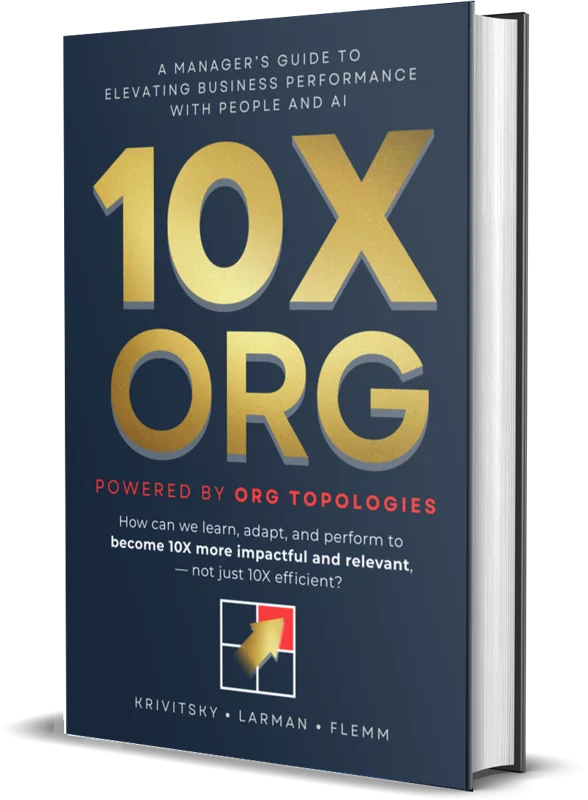
APPENDIX A OF 10X ORG
See the katas at work in 10X ORG
Appendix A of 10X ORG lists every Elevating Kata. The chapters show them at work: the Elevate step of the MADE method, tailwind career paths, multi-team line management and Obeya.
Get the book →ACADEMY
Learn the Org Topologies approach
All upcoming events
 14–15 Oct 2026C-OTCAmsterdamBootcamp – Org Redesign for Agentic Age
 from €1,655 excl. VATLearn moreA two-day, in-person bootcamp for consultants and leaders who redesign organizations. Bring a real case, map it with Org Topologies, and leave with a practical redesign direction and first steps to test it, so AI's speed turns into business results. Includes the path to C-OTC accreditation.
 16 Oct 2026SummitAmsterdamOrg Design Summit 2026Multiple speakers€750 excl. VATLearn moreOrg Design Summit 2026 brings together leaders and practitioners from Product, Tech, HR, and organizational change to explore how organization design shapes performance with people and AI.
 22 Oct 2026OTX-ASTOnlineApplied Systems Thinking
 €395 excl. VATLearn moreA hands-on workshop into the world of Systems Thinking and Systems Modeling
Community
TALK TO THE AUTHORS LIVE
Learn with community
Practitioners share maps, and the authors join the conversation live in Slack.
Join Slack